Beyond the Prescription
The Untapped Role of Belief and Self-Directed Wellness in Parkinson's Care
Beyond the Prescription The Untapped Role of Belief and Self-Directed Wellness in Parkinson’s Care How emerging neuroscience research is revealing that the most powerful tool in Parkinson’s management may already exist inside the patient, and why the UK’s neurological charity sector is uniquely positioned to lead the way.
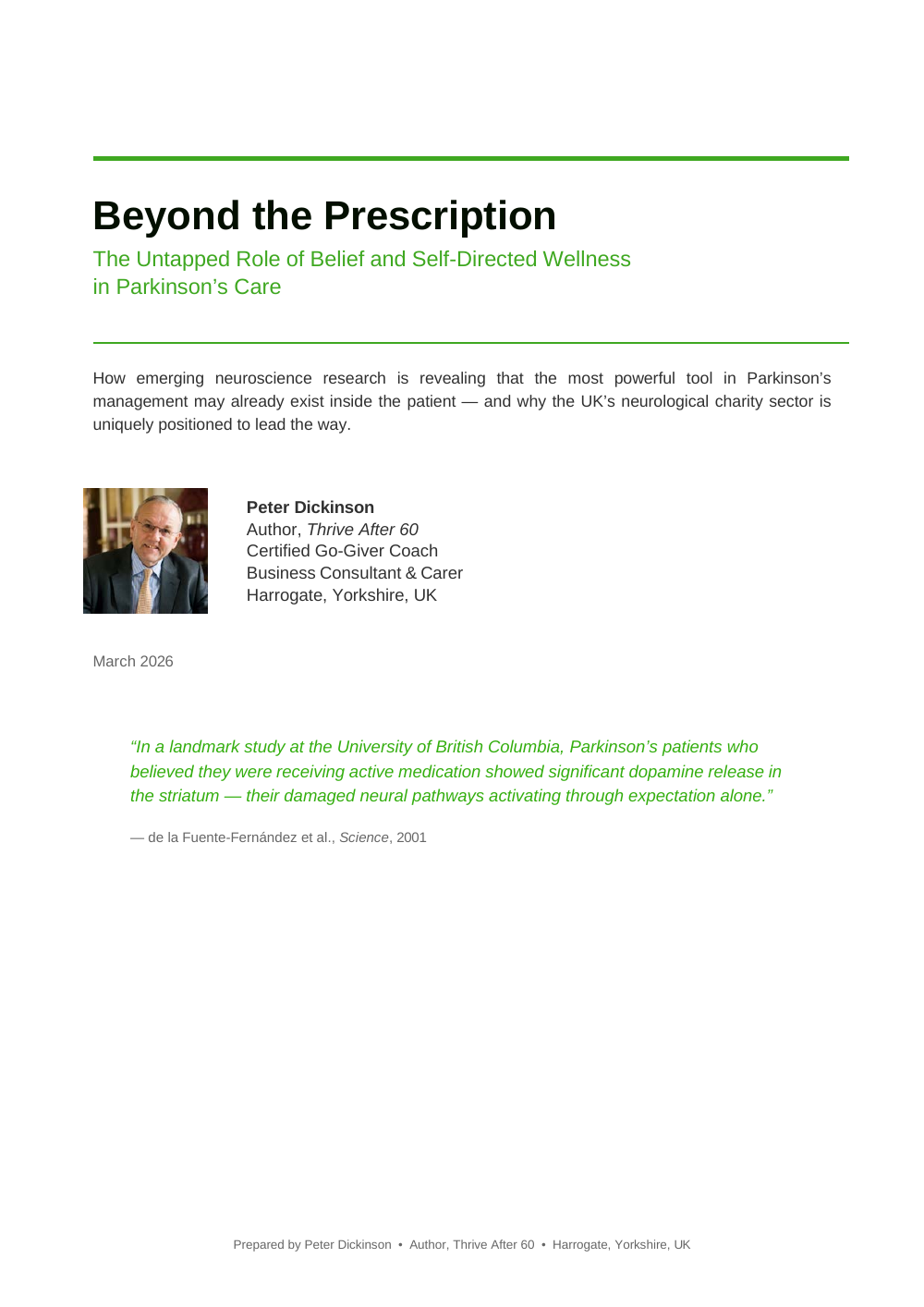
Peter Dickinson
Author, Thrive After 60
Certified Go-Giver Coach
Business Consultant & Carer
Harrogate, Yorkshire, UK
March 2026 “In a landmark study at the University of British Columbia, Parkinson’s patients who believed they were receiving active medication showed significant dopamine release in the striatum, their damaged neural pathways activating through expectation alone.” , de la Fuente-Fernández et al., Science, 2001 Prepared by Peter Dickinson • Author, Thrive After 60 • Harrogate, Yorkshire, UK
Contents
Executive Summary........................................................................... 3 1. The Scale of the Challenge .............................................................. 4 2. The Science: Belief, Dopamine, and Patient Outcomes ..................................... 5 3. The Self-Management Gap in Neurological Care ............................................ 7 4. The Carer Crisis: The Invisible Patient..................................................8 5. A Framework for Belief-Based Wellness....................................................9 6. From Evidence to Practice: A Proposed Pilot Programme .................................. 11 7. Implications for Parkinson’s UK and the Wider Sector ................................... 12 References ................................................................................ 13 About the Author........................................................................... 14 CONFIDENTIAL, Prepared exclusively for Parkinson’s UK by Peter Dickinson
Executive Summary
Approximately 166,000 people in the United Kingdom are currently living with a Parkinson’s diagnosis, with projections indicating this figure will reach 173,000 by 2030. Every day, each of these individuals takes their medication, attends their appointments, and does their best to manage a condition that the medical system treats primarily through pharmacological and surgical intervention. Yet a growing body of peer-reviewed neuroscience research suggests that one of the most powerful variables in Parkinson’s symptom management has been largely overlooked: the patient’s own belief system. Landmark studies conducted at institutions including the University of British Columbia have demonstrated that expectation alone can trigger measurable dopamine release in the damaged striatum of Parkinson’s patients, the very neurochemical pathway that the disease impairs. This white paper examines the published evidence linking patient belief, self-efficacy, and psychological outlook to clinical outcomes in Parkinson’s disease. It identifies a critical gap in current neurological charity programming: while organisations like Parkinson’s UK invest significantly in pharmacological research and clinical support, there exists no standardised, evidence-informed framework for helping patients harness the documented relationship between mindset and symptom management. The paper proposes a practical, volunteer-deliverable pilot programme that could be tested across local Parkinson’s UK support groups, complementing, never replacing, medical treatment. It draws on the author’s lived experience as a daily carer for his wife, who lives with both Parkinson’s disease and multiple sclerosis, as well as 30 years of professional business coaching and a personal commitment to evidence-based self-management. The goal is not to offer a cure. It is to ask a question the neurological charity sector has not yet fully addressed: if belief can measurably alter dopamine activity in Parkinson’s patients, what happens when we give patients a structured, supported framework to work with that knowledge, alongside their existing treatment? 1. The Scale of the Challenge Parkinson’s disease is recognized as the fastest-growing neurological condition worldwide. In the United Kingdom, the scale of the challenge is significant and accelerating.
166,000 | 173,000 | 28,000 people diagnosed in the UK |
projected by 2030 new diagnoses per year
Sources: Parkinson’s UK Prevalence Study, Movement Disorders Clinical Practice, October 2025; Parkinson’s UK Statistics Page, December 2025. A 2025 study published in Movement Disorders Clinical Practice, the most comprehensive prevalence analysis to date, drawing on 18 million GP records alongside hospital admission data, revealed that the true number of people living with Parkinson’s may be substantially higher than previously estimated. Parkinson’s UK estimates that up to 21,000 additional individuals may be living with the CONFIDENTIAL, Prepared exclusively for Parkinson’s UK by Peter Dickinson condition undiagnosed and unsupported. The burden extends well beyond the individual patient. Parkinson’s disease affects motor function, cognitive ability, emotional wellbeing, and social participation. Non-motor symptoms, including depression, anxiety, sleep disturbance, and cognitive impairment, frequently cause greater distress than the motor symptoms that define the clinical diagnosis.
The NHS Capacity Constraint
The National Health Service faces a structural challenge in meeting rising demand for neurological care. Following the coronavirus pandemic, the number of new Parkinson’s diagnoses dropped by approximately 26 percent between 2019 and 2021, and has not returned to pre-pandemic levels. Parkinson’s UK attributes this shortfall not to a decline in incidence, but to long waiting times, a shortage of neurologists, and slow recovery of NHS specialist services. This creates a care gap that will only widen as the population ages. Clinical support alone cannot scale proportionally to meet rising demand. The sector needs complementary approaches, structured, evidence-informed self-management resources that patients and caregivers can access between clinical appointments, without requiring direct clinical supervision.
Beyond Medication: The Whole-Person Imperative
Patients and their families are increasingly vocal about a fundamental need: support that addresses quality of life, not just disease management. The 2025 NICE guideline on rehabilitation for chronic neurological disorders (NG252) explicitly recommends holistic, person-centered rehabilitation that considers physical, cognitive, emotional, and social dimensions of wellbeing. This guideline reinforces what patients have been saying for years: medication alone is not enough. The organizations best positioned to bridge this gap are the neurological charities that already serve these communities, Parkinson’s UK chief among them, with over 350 local support groups across England, Wales, Scotland, and Northern Ireland. 2. The Science: Belief, Dopamine, and Patient
Outcomes
The relationship between expectation and clinical outcome in Parkinson’s disease is not speculative. It is one of the most extensively documented placebo phenomena in all of medicine, supported by peer-reviewed research from leading neuroscience institutions.
The Landmark Dopamine Discovery
In 2001, a research team led by Dr. Raúl de la Fuente-Fernández at the University of British Columbia published a groundbreaking study in the journal Science. Using positron emission tomography (PET) scanning with a radioactive tracer called [11C]raclopride, they provided the first direct, in vivo evidence that placebo administration triggers substantial release of endogenous dopamine in the striatum of Parkinson’s patients. To appreciate the significance of this finding, consider what Parkinson’s disease fundamentally is: a progressive loss of dopamine-producing neurons in the brain. Every pharmacological treatment for CONFIDENTIAL, Prepared exclusively for Parkinson’s UK by Peter Dickinson Parkinson’s aims to compensate for this dopamine deficit. The UBC study demonstrated that belief alone, the patient’s expectation that they were receiving active treatment, activated the very same dopaminergic pathway that the disease degrades. The researchers concluded that the placebo effect in Parkinson’s disease is powerful and operates through activation of the damaged nigrostriatal dopamine system itself. , de la Fuente-Fernández et al., Science, 293(5532), 2001
The Role of Expectation Strength
A subsequent study by the same research group, published in Archives of General Psychiatry (now JAMA Psychiatry) in 2010, examined how the strength of patient expectation influences the magnitude of dopamine release. Thirty-five patients with mild to moderate Parkinson’s disease were told they had varying probabilities, 25%, 50%, 75%, or 100%, of receiving active medication, when in fact they received a placebo. The results revealed that significant dopamine release occurred when patients believed they had a 75% probability of receiving real treatment. The study demonstrated that the strength of belief directly modulates dopamine release in the Parkinson’s brain. This is not a generic relaxation response or general wellness effect. It is a specific, measurable, neurochemical change in the precise brain region affected by the disease.
Converging Evidence
These findings do not stand in isolation. A substantial body of research has since confirmed and expanded upon the placebo-dopamine connection in Parkinson’s disease: Single-neuron recording studies have demonstrated that placebo response is associated with measurable changes in the firing patterns of individual neurons within the basal ganglia circuit, the brain region most directly affected by Parkinson’s. Clinical trial data consistently shows that Parkinson’s patients assigned to placebo groups demonstrate motor improvement of 20, 30% on the Unified Parkinson Disease Rating Scale, with effects lasting up to six months in some studies. Surgical trial placebos produce even larger effects. Neuroimaging meta-analyses confirm that placebos stimulate dopamine release in both the dorsal striatum (associated with motor function) and the ventral striatum (associated with reward and motivation). Critically, the expectation of reward, not the reward itself, is what drives the ventral striatum response. What This Means for Patients The implications of this research are profound but must be stated precisely. This evidence does not suggest that patients can think their way out of Parkinson’s disease. Neurodegeneration is a biological reality that requires medical treatment. What the evidence does demonstrate is that a patient’s psychological state, their expectations, beliefs, and sense of agency, has a measurable, physiological impact on the very brain systems that Parkinson’s compromises. If belief can activate dopamine release in a damaged brain, then actively supporting patients in developing positive expectations, self-efficacy, and a sense of personal agency is not a “nice-to-have” complement to medical care. It is a clinically relevant intervention that the current care model does not CONFIDENTIAL, Prepared exclusively for Parkinson’s UK by Peter Dickinson systematically address.
3. The Self-Management Gap in Neurological Care
Despite the robust evidence linking psychological factors to Parkinson’s outcomes, a significant gap exists between what the research shows and what patients actually receive. What the Research Recommends A 2022 scoping review of self-management interventions for Parkinson’s disease, published in the Journal of Medical Internet Research, identified an expanding body of evidence that structured self-management programmes can improve physical function, quality of life, and patient-reported outcomes. Five of eight randomised controlled trials reviewed found significant positive results for primary outcomes including reduced fall rates, improved daily activity performance, and enhanced quality of life. A separate systematic review of qualitative evidence on self-management components identified seven key themes that effective programmes should address: medication management, physical exercise, self-monitoring techniques, psychological strategies, maintaining independence, encouraging social engagement, and providing knowledge and information. Critically, self-efficacy, the patient’s belief in their ability to manage their own condition, has been consistently identified as a primary predictor of successful self-management in Parkinson’s disease. A 2019 cross-sectional study across three medical centres found that self-efficacy and social support were the strongest determinants of self-management behaviour, explaining significant additional variance beyond demographic and clinical factors.
What Patients Currently Receive
The contrast between this evidence base and current practice is stark. Most Parkinson’s patients in the UK receive pharmacological treatment, periodic neurologist consultations, and access to physiotherapy and occupational therapy where available. The 350+ local support groups operated by Parkinson’s UK provide invaluable community and peer connection, but their programming typically centres on medical updates, exercise sessions, and social activities. What is largely absent is a structured, evidence-informed programme that helps patients develop the psychological resources, self-efficacy, positive expectation, cognitive reappraisal, and a sense of personal agency, that the neuroscience literature has shown to be directly relevant to dopamine function and symptom management. This is not a criticism of current services. It reflects the fact that the research linking belief to dopamine release in Parkinson’s, while published in leading scientific journals, has not yet been translated into practical, deliverable programming at the community level. The opportunity is to bridge that translation gap.
The UK Qualitative Evidence
A 2022 UK-based qualitative study explored how people living with Parkinson’s actually self-manage their condition. The findings reinforced a critical insight: patients whose self-identity incorporated their Parkinson’s diagnosis, who accepted the condition as part of who they are rather than something CONFIDENTIAL, Prepared exclusively for Parkinson’s UK by Peter Dickinson imposed upon them, showed less psychological distress and better self-management outcomes. Those whose self-esteem and self-efficacy were most affected by the diagnosis struggled most with daily management. A 2025 Dutch focus group study of people living with Parkinson’s reinforced these findings, identifying mindset, lifestyle, and social support as the three primary factors influencing coping. Patients who developed a proactive, task-oriented approach reported feeling better equipped to handle their condition and more willing to seek support. The consistent message from the qualitative literature is that how patients think about their condition materially affects how well they manage it and that the neurological charity sector has an opportunity to systematically support this psychological dimension.
4. The Carer Crisis: The Invisible Patient
Behind every person living with Parkinson’s, there is frequently another person whose wellbeing is quietly deteriorating: their carer. In the United Kingdom, an estimated 6.5 million people provide unpaid care. Research indicates that around 48% of current carers have experienced a new or worsening mental or physical health condition since taking on caring responsibilities. More than half face disadvantages in managing their own health. For those providing 50 or more hours of care per week, a threshold that many Parkinson’s carers exceed, the mental health impact is even more severe. Carer burnout in the neurological space carries distinct characteristics. Unlike caring for a patient who may recover, caring for someone with a progressive neurological condition means adjusting to incremental decline. The carer’s role expands continuously: from occasional help to constant supervision, from emotional support to physical assistance with daily activities. The psychological toll is compounded by grief for the person their partner used to be, alongside the practical demands of medication schedules, clinical appointments, and the management of unpredictable symptoms.
A Personal Perspective
I write about this with more than academic understanding. My wife lives with both Parkinson’s disease and multiple sclerosis. I am her daily carer. I manage the appointments, the medication schedules, the physiotherapy diary, and the conversations that families would rather not have. I understand the isolation, the identity erosion, and the quiet exhaustion that caring creates, because I live it every day. That experience is also what drives this paper. When I began researching the relationship between belief and neurological outcomes, it was not for an academic exercise. It was because I watched my wife take her medication every morning and wondered: what else could we be doing? What does the science actually say about the role of mindset, expectation, and psychological wellness in conditions like hers? What I found was a substantial, peer-reviewed evidence base that had not yet been translated into practical resources for patients or their carers. This white paper is an attempt to begin that translation.
Why Carers Need This Framework Too
Any programme designed to support Parkinson’s patients through belief-based wellness must also CONFIDENTIAL, Prepared exclusively for Parkinson’s UK by Peter Dickinson serve their carers. Carer wellbeing directly influences patient outcomes: a burnt-out, depressed carer cannot provide the consistent, positive support that reinforces a patient’s sense of agency and hope. Conversely, a carer who has their own self-management framework, who believes they can influence their circumstances rather than simply endure them, is better equipped to support their partner through the daily realities of neurological disease. The proposed pilot programme described in Section 6 incorporates carer wellness as a core component, not an afterthought. 5. A Framework for Belief-Based Wellness Translating the neuroscience of expectation and self-efficacy into a practical, community-level programme requires a framework that is grounded in evidence, safe for vulnerable populations, and deliverable without clinical supervision.
Core Principles
Complementary, never alternative. This framework is designed to work alongside existing medical treatment. Every element explicitly reinforces the importance of continuing prescribed medication and maintaining clinical relationships. The message is consistent: keep taking your medication. Follow your consultant’s advice. And in addition to those essential steps, here are evidence-based practices that can support your overall wellbeing. Evidence-cited throughout. Every recommendation is grounded in published research from peer-reviewed journals. No claims extend beyond the evidence. Where the research suggests association rather than causation, the framework is explicit about that distinction. Patient agency, not patient instruction. The framework’s goal is to help patients and carers develop their own sense of agency and self-efficacy, not to prescribe a rigid protocol. Autonomy and personal choice are central to the approach, consistent with the self-determination theory that underpins much of the self-management research.
The Five Pillars
Pillar: Physical Wellness
Practical guidance on movement, nutrition, and sleep, the foundational elements of physical selfmanagement. Emphasis on walking (shown to be the most accessible and sustainable exercise for Parkinson’s patients), hydration, and dietary patterns that support neurological function.
Pillar: Mental Wellbeing
Strategies for managing depression, anxiety, and cognitive challenges, the non-motor symptoms that often cause greater distress than motor impairment. Includes cognitive reappraisal techniques and the cultivation of positive expectations, drawing on the dopamine-expectation research.
Pillar: Social Connection
Structured approaches to combating the isolation that both patients and carers experience. Emphasis on peer support, community engagement, and maintaining relationships. Evidence consistently identifies social support as a primary determinant of self-management success. CONFIDENTIAL, Prepared exclusively for Parkinson’s UK by Peter Dickinson Pillar: Purpose and Identity Helping patients and carers maintain a sense of identity and purpose beyond the diagnosis. The qualitative research is clear: patients who integrate their condition into a broader sense of self, rather than being defined by it, manage better. Pillar: Belief and Self-Efficacy The distinctive element of this framework. Structured practices designed to cultivate the patient’s belief in their own capacity to influence their wellbeing. This is where the dopamine-expectation research meets practical application: meditation, visualisation, goal-setting, and progressive achievement milestones that generate measurable psychological engagement. These five pillars map directly to the chapter structure of Thrive After 60, the published book that provides the full narrative framework for this approach. The white paper programme condenses the most evidence-relevant elements into a structured, group-deliverable format.
6. From Evidence to Practice: A Proposed Pilot
Programme
The following pilot programme is proposed for evaluation within Parkinson’s UK’s local support group network. It is designed to be deliverable by volunteer group facilitators with minimal training, requiring no clinical supervision.
Programme Structure
Duration: 8 weeks, with one 90-minute group session per week. Participants: People living with Parkinson’s and their carers, attending together. Delivery: Facilitated by trained volunteers using a structured session guide. No clinical background required. Location: Existing local Parkinson’s UK support group venues.
Week
Theme
Focus
1 Understanding Your Power |
Introduction to the science of belief and dopamine. The placebo research in Parkinson’s. Setting personal wellness goals.
2 Moving With Purpose |
Physical wellness pillar. Walking programmes. Movement as medicine.
3 Feeding Your Brain |
Nutrition and neurological health. Practical dietary guidance.
4 Quieting the Mind |
Mental wellbeing. Meditation and mindfulness. Managing anxiety and low mood.
5 Staying Connected |
Social connection strategies. Combating isolation for patients and carers. CONFIDENTIAL, Prepared exclusively for Parkinson’s UK by Peter Dickinson
6 Rediscovering Purpose |
Identity and purpose beyond diagnosis. Goal setting and personal projects.
7 The Belief Toolkit |
Practical self-efficacy exercises. Visualisation, journaling, progressive milestones.
8 Your Ongoing Practice |
Integrating all five pillars. Creating a personal daily wellness routine. Measuring progress and next steps.
Measurement
The pilot would measure patient-reported outcomes at baseline (Week 1) and completion (Week 8) using validated instruments including the PDQ-39 (Parkinson’s Disease Questionnaire) for quality of life, the General Self-Efficacy Scale for perceived self-management capability, and a brief carer wellbeing measure. Qualitative feedback would be gathered through structured group discussions at Weeks 4 and 8.
Proposed Pilot Sites
Three Parkinson’s UK local support groups in Yorkshire would provide an ideal pilot environment: Harrogate, Leeds, and York. The author is based in Harrogate and can personally facilitate the initial sessions alongside trained volunteers, ensuring programme fidelity before handover to a fully volunteer-led model. This pilot carries no cost to Parkinson’s UK. All programme materials, facilitation, and measurement instruments would be provided by the author. The charity’s contribution would be access to three willing local groups and a liaison contact within the community services team. 7. Implications for Parkinson’s UK and the Wider Sector The evidence reviewed in this paper points to a strategic opportunity for the neurological charity sector. The organisation that develops the first credible, research-backed, community-deliverable framework for belief-based wellness in Parkinson’s care will establish a distinctive position in patient support, one that no competitor currently occupies.
For Patients
A structured self-management programme grounded in the dopamine-expectation research gives patients something that current programming does not: a scientifically supported reason to believe they have agency in their own care. Not false hope. Not alternative medicine. Published neuroscience translated into practical daily habits, delivered in the community they already trust.
For Carers
Including carers as full participants, not observers, addresses the carer burnout crisis with a framework that says: you are not powerless. Your wellbeing matters. And the same principles that can help your partner can help you. CONFIDENTIAL, Prepared exclusively for Parkinson’s UK by Peter Dickinson
For Local Support Groups
Many of Parkinson’s UK’s 350+ local groups face programming fatigue, a cycle of medical updates and exercise sessions that, while valuable, does not fully address the psychological and emotional dimensions of living with a progressive condition. A fresh, evidence-based, interactive programme on mindset and self-management could reinvigorate group attendance and volunteer engagement. For the Organisation Parkinson’s UK has invested in research that will one day change the medical landscape for patients. This programme complements that investment by addressing what patients can do today, alongside their existing treatment, to improve their quality of life. It is the kind of whole-person programming that donors increasingly expect and that differentiates a charity from its peers. If the Yorkshire pilot produces positive patient-reported outcomes, the programme could scale nationally across the support group network. A digital version, accessible to patients who cannot attend group sessions, could extend reach further still. The data generated would also contribute to the broader research base on self-management in neurological conditions, positioning Parkinson’s UK at the forefront of whole-person neurological care. CONFIDENTIAL, Prepared exclusively for Parkinson’s UK by Peter Dickinson
References
1. de la Fuente-Fernández, R., Ruth, T.J., Sossi, V., et al. (2001). Expectation and dopamine release: mechanism of the placebo effect in Parkinson’s disease. Science, 293(5532), 1164, 1166. 2. de la Fuente-Fernández, R., Phillips, A.G., Zamburlini, M., et al. (2002). Dopamine release in human ventral striatum and expectation of reward. Behavioural Brain Research, 136(2), 359, 363. 3. Lidstone, S.C., Schulzer, M., Dinelle, K., et al. (2010). Effects of expectation on placebo-induced dopamine release in Parkinson disease. Archives of General Psychiatry, 67(8), 857, 865. 4. Stoessl, A.J., Lehericy, S., Bherer, L., et al. (2014). Great expectations: the placebo effect in Parkinson’s disease. In Handbook of Experimental Pharmacology, 225, 139, 154. 5. Frisaldi, E., Shaibani, A., Bhidayasiri, R., et al. (2020). Placebo responses in Parkinson’s disease. International Review of Neurobiology, 153, 187, 231. 6. Parkinson’s UK (2025). Parkinson’s prevalence in the United Kingdom. Published in Movement Disorders Clinical Practice, October 2025. parkinsons.org.uk/statistics 7. Parkinson’s UK (2025). Thousands are living with Parkinson’s undiagnosed and unsupported. Press release, 22 October
2025. 8. National Institute for Health and Care Excellence (2025). Rehabilitation for chronic neurological disorders including acquired |
brain injury [NG252]. nice.org.uk/guidance/ng252 9. Kang, H., Kim, S.R., Han, K., et al. (2019). Factors influencing self-management in Parkinson’s disease: A cross-sectional study. Experimental Neurobiology. 10. Tuijt, R., Tan, A., Armstrong, M., et al. (2020). Self-management components as experienced by people with Parkinson’s disease and their carers: A systematic review and synthesis. Parkinson’s Disease, 2020, 8857385. 11. Pigott, J.S., Armstrong, M., Walters, K., et al. (2022). People with Parkinson’s perspectives and experiences of self-management: Qualitative findings from a UK study. PLOS ONE, 17(9), e0273428. 12. van Munster, M., et al. (2025). Navigating life with Parkinson’s disease: A focus group study on coping strategies and considerations for self-management support. Health Expectations. 13. Jethani, P.M., Toglia, J., Foster, E.R. (2024). Cognitive self-efficacy in Parkinson’s disease. OTJR: Occupational Therapy Journal of Research. 14. Kaddumukasa, M., et al. (2021). Determinants of self-efficacy in patients with Parkinson’s disease. Neurología. 15. Gilbody, S., et al. (2022). Self-management interventions for people with Parkinson disease: Scoping review. Journal of Medical Internet Research. 16. Carers UK (2024). State of Caring report. carersuk.org 17. CarefreeSPACE (2025). Carer burnout statistics. carefreespace.org 18. Michael J. Fox Foundation (2025). Ask the MD: Placebo and Parkinson’s. michaeljfox.org 19. Stoessl, A.J. (2006). Placebo effect and dopamine release. Journal of Neural Transmission, Suppl. 70, 349, 352. CONFIDENTIAL, Prepared exclusively for Parkinson’s UK by Peter Dickinson
About the Author
Peter Dickinson is the author of Thrive After 60: How to Live Your Best Life in Retirement and Have Financial Freedom, a self-help guide for people entering their third age. The book draws on his personal journey from a challenging childhood through a 30-year corporate career in technology sales to a transformative spiritual awakening that reshaped his understanding of human potential. Peter is a Certified Go-Giver Coach, endorsed by bestselling author Bob Burg, and has spent more than 20 years as a high-growth business consultant through Harrogate Business Advisors. His professional career spans two decades at ICL/Fujitsu, Amdahl, and multiple consultancy roles across the United Kingdom and internationally. His perspective on Parkinson’s care is rooted in lived experience. His wife has been diagnosed with both Parkinson’s disease and multiple sclerosis. As her daily carer, Peter brings an understanding of the condition that is both intimate and practical, informed by the realities of medication management, clinical appointments, and the daily negotiation with unpredictable symptoms. Peter’s approach is guided by a single principle: serve first, without expectation. This white paper is offered in that spirit, as a contribution to the conversation about how we can better support the 166,000 people in the UK living with Parkinson’s, and the families who care for them.
Contact
Peter Dickinson
Email: peter@hbadvisors.co.uk Phone: +44 7917 679050 Web: www.hbadvisors.co.uk | www.lightworkercoach.co.uk LinkedIn: linkedin.com/in/peterdickinsonsalesconsultant CONFIDENTIAL, Prepared exclusively for Parkinson’s UK by Peter Dickinson
Download the full white paper
Get the PDF delivered to your inbox.