The State of Community Health Innovation
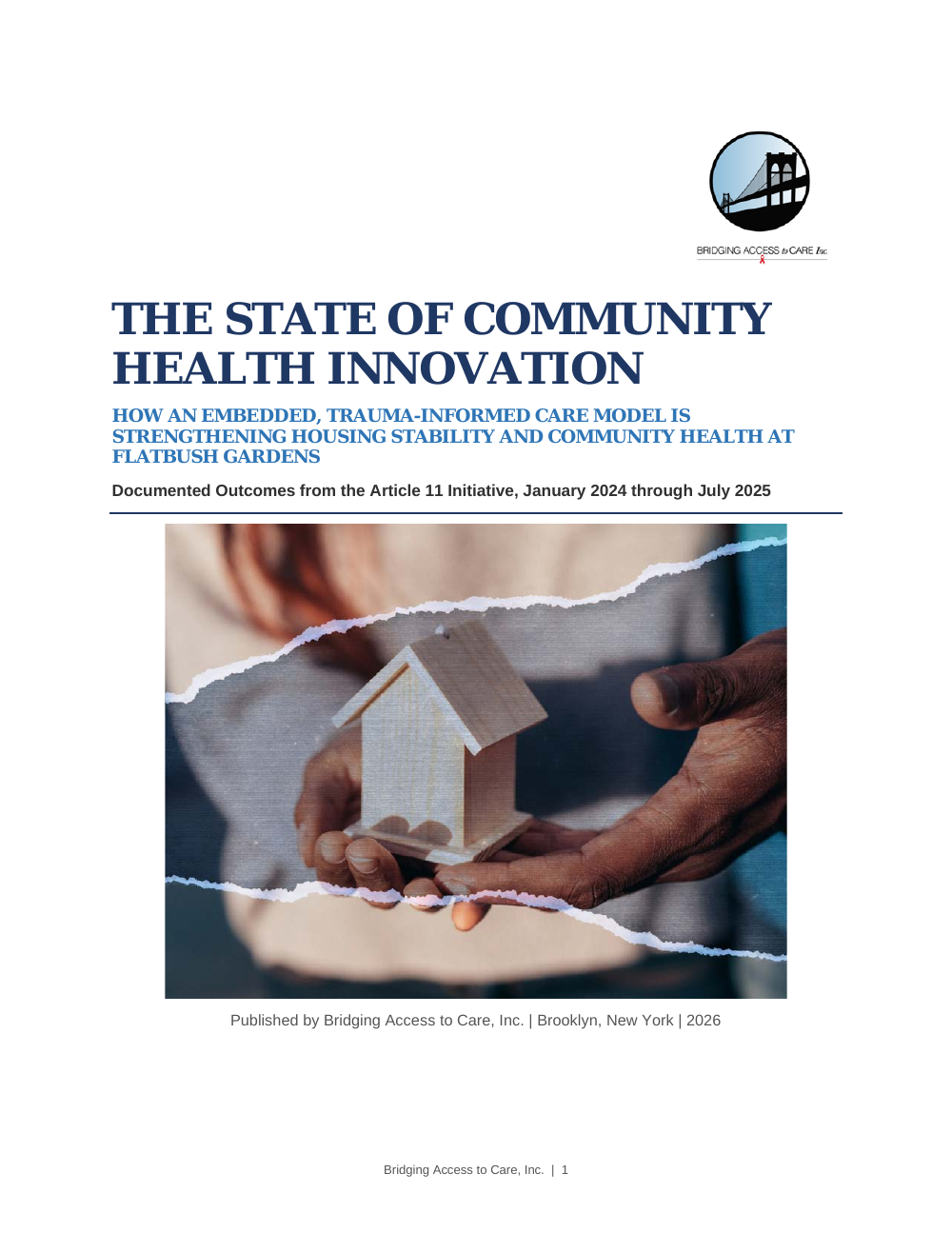
How an embedded, trauma-informed care model is strengthening housing stability and community health at Flatbush Gardens.
THE STATE OF COMMUNITY
HEALTH INNOVATION
HOW AN EMBEDDED, TRAUMA-INFORMED CARE MODEL IS
STRENGTHENING HOUSING STABILITY AND COMMUNITY HEALTH AT
FLATBUSH GARDENS
Documented Outcomes from the Article 11 Initiative, January 2024 through July 2025 Published by Bridging Access to Care, Inc. | Brooklyn, New York | 2026
Bridging Access to Care, Inc. | 1
Executive Summary
For decades, the standard approach to supportive housing has followed a simple formula: provide housing, then refer residents out to a fragmented network of social services. This report presents evidence for a different model: a Housing First, trauma-informed approach that embeds comprehensive care directly inside the residential community. In 2023, Clipper Realty entered a 40-year regulatory agreement with the New York City Department of Housing Preservation and Development (HPD) under Article XI of the Private Housing Finance Law for Flatbush Gardens, a 2,500-unit complex in Brooklyn, including a setaside of units for formerly homeless households. Bridging Access to Care, Inc. (BAC) partnered with Clipper Equity to deliver on-site services under that program. This paper reports documented outcomes from January 2024 through July 2025, during which 213 formerly homeless tenants were onboarded into permanent housing with on-site support. Documented outcomes from the reporting period include: • 213 formerly homeless Article 11 tenants onboarded into permanent housing, with 117 onboarding surveys completed • More than 372 documented tenant service interactions addressing housing, food insecurity, employment, behavioral health, legal needs, and wellness • 81 of 107 surveyed tenants reported feeling safe and comfortable in their new housing environment • 44 tenant concerns and complaints addressed and resolved, with most referrals and concerns addressed within one week • More than 50 community wellness events with more than 900 resident participations The evidence supports a specific conclusion: the embedded care model functions as a community stabilization platform. It improves housing security, increases behavioral health engagement, addresses social determinants of health, strengthens social cohesion, and prevents crises through early intervention and peer-led support. These are the outcomes most strongly associated in published research with improved health and long-term housing stability. This report is written for property management executives and housing authorities, healthcare administrators and behavioral health providers, policymakers, philanthropic organizations focused on housing and health equity, and community health organizations evaluating service models.
Bridging Access to Care, Inc. | 2
Introduction: The Housing and Health Intersection Each year, thousands of people transition from homelessness into permanent housing, and a substantial share return to instability within one to two years. The cost of that cycle is well documented: University of Pennsylvania research by Dennis Culhane and colleagues found that homeless individuals with severe mental illness used roughly $40,500 per person per year in publicly funded services, most of it in emergency rooms, psychiatric hospitals, shelters, and jails. The conventional explanation places responsibility on the individual: the person was not "housing ready," could not manage their mental health, or made poor choices. The evidence points elsewhere. People exiting homelessness often carry untreated trauma, unmanaged chronic conditions, and fractured social connections. The systems built to support them require those same individuals to find their way through a maze of disconnected agencies while adjusting to housing itself. Published research consistently finds that a large majority of adults experiencing chronic homelessness report significant trauma histories, and homelessness itself, through loss of safety, autonomy, and social connection, compounds that trauma. Bridging Access to Care, a Brooklyn-based community health organization founded in 1986, has spent more than three decades serving marginalized communities through behavioral health treatment, substance use services, HIV/AIDS care, and chronic disease management. Under the 2023 Article XI agreement at Flatbush Gardens, BAC partnered with Clipper Equity to test a proposition: that housing stability improves when comprehensive care is delivered inside the building, from day one, by a team that includes residents themselves. This paper describes that model, presents the documented outcomes of its Article 11 initiative from January 2024 through July 2025, and outlines the measurement agenda and policy conditions required to evaluate and replicate it.
Section 1: Why Referral-Based Service Models
Underperform
The conventional model for supporting people transitioning from homelessness has three steps: secure housing, refer the resident to outside services, and monitor lease compliance. The model fails predictably, and the failure points are well documented. Studies of service access among people exiting homelessness document the same pattern across systems: long waits for behavioral health appointments, missed connections caused by transportation and paperwork requirements, and residents who stop seeking help before care ever begins. Six structural barriers recur across referral-based systems: • Geographic fragmentation. Services scattered across neighborhoods create access barriers for people with limited mobility, transportation, or income.
Bridging Access to Care, Inc. | 3
• Administrative burden. Each agency requires separate intake, documentation, and appointments. For someone managing cognitive or executive function challenges, the paperwork itself becomes a barrier to care. • Siloed systems. Mental health, medical, substance use, and housing providers rarely communicate. No single provider sees the whole person. • Waitlists and capacity constraints. The people who need services most urgently often face the longest waits, which makes crisis the fastest path to access. • Cultural and language barriers. Services designed without linguistic access or cultural grounding exclude the residents they are intended to reach. • Trauma replication. For individuals with histories of abandonment, "go somewhere else" repeats the original injury. Referral-based systems can reproduce the dynamics of the trauma they are meant to treat. A seventh problem compounds the six: referral systems are reactive. By the time a resident seeks help, the situation is often already a crisis, so the service relationship begins in emergency rather than in trust. Trauma-informed care literature identifies safety, trustworthiness, peer support, collaboration, and empowerment as the conditions under which recovery occurs. A fragmented, appointment-gated, crisis-driven system offers few of them. Viewed through a service design lens, this evidence suggests the core defect is structural rather than individual: the gap between where people live and where help is delivered. The implication for housing and health organizations is direct. Closing that gap, physically and relationally, is the design problem to solve.
Section 2: The Embedded Care Model
The embedded care model closes the gap by placing a comprehensive care team inside the residential community itself. Seven components define the model as implemented at Flatbush Gardens.
Bridging Access to Care, Inc. | 4
The seven core components of the embedded care model as implemented at Flatbush Gardens. 1. Physical presence in the building A dedicated, visible, non-clinical office inside the complex, open for walk-ins on weekdays and weekends, with hours that extend beyond 9 to 5. Residents can stop in on the way to the mailboxes. Help is located where people already are. 2. Day-one engagement Staff or Community Ambassadors greet new residents at key pick-up with a warm welcome, a simple one-page introduction to services in the resident’s language, and a no-pressure invitation, followed by a check-in within the first week. Engagement begins before problems develop, not after. 3. A comprehensive service array Behavioral health screening and counseling, psychiatric consultation, substance use treatment on a harm reduction basis, chronic disease care coordination, benefits enrollment, food access, employment and education support, and legal navigation, all delivered or coordinated on site. 4. A trauma-informed, low-barrier approach No appointment required for a first visit. No intake paperwork before a relationship exists. No sobriety requirements. Culturally responsive services in the languages residents speak. The design
Bridging Access to Care, Inc. | 5
principle is to remove every administrative step that stands between a resident and a first conversation. 5. The Community Ambassador program Residents of the building are trained and paid as community health workers. Ambassadors receive initial training in trauma-informed care, mental health first aid, harm reduction, and care navigation, with ongoing supervision from clinical staff. They conduct outreach, check on isolated neighbors, de-escalate conflicts, connect residents to services, and organize community events. Because Ambassadors live in the building, share languages and lived experience with their neighbors, and are present in hallways and laundry rooms rather than offices, they reach residents that professional outreach alone does not. The program also creates paid employment and a career pathway for residents who are often excluded from the labor market. 6. Coordination with property management When management identifies a concern, such as late rent or a conflict between neighbors, the care team makes contact and offers support, with the resident’s awareness, before the situation escalates to enforcement. The care team maintains clinical independence and confidentiality; management retains responsibility for safe, functional housing. The arrangement replaces a punitive default with a supportive one. 7. Data collection and continuous improvement The program tracks service utilization, tenant concerns and resolution times, survey responses, and event participation, and reviews the data with both partners to refine the program.
Section 3: Documented Outcomes at Flatbush Gardens,
January 2024 through July 2025 Flatbush Gardens comprises 2,500 units across 59 buildings in East Flatbush, home to roughly 10,000 residents, a culturally and linguistically diverse community with a significant population arriving directly from the shelter system. The 2023 Article XI agreement between Clipper Realty and HPD set aside 250 units for formerly homeless households referred through HPD. Joshua "JJ" Bistricer, partner and Chief Operating Officer of Clipper Equity, engaged BAC to build the embedded care program, with Clipper Equity providing dedicated office space and core program funding, and BAC providing the clinical team, program design, Community Ambassadors, and evaluation. The outcomes below are drawn from BAC’s Article 11 program documentation for January 2024 through July 2025: onboarding assessments, service interaction logs, tenant surveys, and complaint resolution records. They are reported as documented, without extrapolation.
Bridging Access to Care, Inc. | 6
Community engagement is the entry point for every service the program delivers. Housing stability • 213 formerly homeless Article 11 tenants were onboarded into permanent housing; by December 31, 2025, the cumulative total reached 249 individuals and families. • 117 onboarding surveys were completed. • 81 of 107 surveyed tenants reported feeling safe and comfortable in their new housing environment. • 36 of 110 tenants requested immediate support services during onboarding. • More than 372 tenant service interactions were documented, addressing housing, food insecurity, employment, behavioral health, legal needs, and wellness. • Housing assistance was the largest category of tenant requests, with 136 documented interventions, alongside ongoing lease renewal and housing navigation support. These are observable program facts. Viewed through a housing stability lens, they indicate that placement combined with immediate, on-site service engagement establishes the foundation on which long-term retention is built. The implication for the field is that the first weeks of tenancy, not the first crisis, are the correct point of intervention.
Bridging Access to Care, Inc. | 7
All seven categories from the BAC Article 11 visitor log, January 2024 through July 2025. Categories mix service requests and engagement measures as the source report records them. Behavioral health engagement • The progress report identifies mental wellness as one of the leading service requests, after housing and food access. • 40 mental wellness interventions were documented during the reporting period. • Behavioral health referrals consistently ranked among the most used referral categories. • Follow-up on behavioral health and substance use referrals occurred within one week. • Enrollment into behavioral health support programs was typically completed within 30 days. The program does not yet hold healthcare claims data, so this paper makes no claim about hospitalizations or emergency department utilization. What the documentation shows directly is rapid identification, referral, and linkage: residents raising behavioral health needs were contacted within a week and enrolled in support programs within a month. In fragmented referral systems, follow-up commonly takes weeks or months; a one-week follow-up standard is itself a material outcome. Response measure Documented timeframe Follow-up on behavioral health and substance use referrals Within one week Resolution of most tenant referrals and concerns Within one week Housing maintenance and repair concerns Generally 2 to 7 days Enrollment into behavioral health support programs Typically within 30 days
Bridging Access to Care, Inc. | 8
Source: BAC Article 11 program documentation, January 2024 through July 2025. Crisis prevention and community stabilization • 44 tenant concerns and complaints were addressed and resolved. • Most referrals and tenant concerns were addressed within one week. • Housing maintenance and repair concerns were generally resolved within 2 to 7 days through coordinated intervention with property management. • BAC staff and Community Ambassadors provided conflict mediation, crisis response, and problem-solving support before issues escalated, and trauma-informed interventions reduced recurring behavioral incidents. Resolved concerns and short resolution times are proxy measures rather than direct crisis counts. Read as proxies, they indicate a community in which problems surface early and are settled before they reach eviction proceedings, emergency calls, or court. The question this raises for property owners is what comparable concerns cost, in management time and legal expense, in buildings without an embedded team. Social determinants of health The strongest frame for the program’s health impact is the social determinants of health: the housing, food, economic, and social conditions that published research links to the majority of health outcomes. The documented record maps directly onto those determinants.
Determinant
Documented outcomes Housing stability 213 households transitioned into permanent housing in the reporting period; 136 housing-related interventions; ongoing lease renewal and stabilization assistance Food security 64 food pantry interventions; 720 participations in nutrition and produce giveaways; nutrition support programs for older adults Economic stability 55 employment assistance interventions; job fairs, workforce readiness activities, and educational referrals Social connection More than 50 community wellness events with more than 900 resident participations; 78 of 111 surveyed tenants interested in community activities; Ambassador engagement reducing isolation Documented social determinants of health outcomes, January 2024 through July 2025.
Bridging Access to Care, Inc. | 9
Source: BAC tenant surveys, 107 and 111 respondents respectively. Each of these measures is direct, countable, and reproducible at other sites. Together they document a program acting on the conditions that drive health, rather than estimating the downstream healthcare effects of doing so.
Section 4: Financial and System Value
Earlier descriptions of this program emphasized estimated healthcare savings. This paper takes a stricter standard: value is claimed only where it is documented, and projected value is labeled as projection. On that standard, the model’s financial case rests on three distinct beneficiaries. For property owners The documented record shows faster resolution of tenant concerns, reduced property management burden, increased lease compliance support, improved communication between tenants and management, reduced escalation of conflicts, and stronger resident engagement and retention. These translate into avoided legal costs, lower turnover, and less staff time absorbed by crisis response. Quantifying those savings per building is part of the measurement agenda in
Section 5.
For government The model supports successful transitions from homelessness into permanent housing, prevention of housing disruption, increased access to behavioral health treatment, and better utilization of existing public benefits. Each prevented return to the shelter system avoids the cost pattern the University of Pennsylvania research documented: roughly $40,500 per person per year in publicly funded emergency and institutional services. For healthcare systems Direct healthcare claims data are not currently available for this program, and this paper therefore makes no claim of realized healthcare savings. Published research on Housing First and supportive housing models consistently finds that stable housing, behavioral health engagement, and reduced social isolation are associated with lower utilization of crisis-driven healthcare
Bridging Access to Care, Inc. | 10
services. The Flatbush Gardens record documents those precursor conditions: stable tenancies, one-week behavioral health follow-up, and measurable gains in food security and social connection. Viewed through that research base, the documented outcomes suggest likely downstream healthcare benefits. Confirming them requires the claims data partnerships described below.
Section 5: A Measurement Agenda
The gap between what this program demonstrably does and what it can currently prove defines its next phase of evaluation. Four metric families would move the evidence from engagement indicators to outcome claims. Metric family
Measures
Housing stability Housing retention at 6, 12, and 24 months; lease renewal completion rates; eviction filings prevented; housing court interventions; rent arrears resolved Behavioral health Screening completion; referral completion rates; psychiatric evaluations completed; counseling engagement rates; crisis intervention episodes
Community
stabilization Tenant complaints resolved; repeat complaints prevented; social isolation screenings; resident participation rates; Community Ambassador contacts Healthcare influence Self-reported emergency room use; self-reported hospitalization; primary care engagement; medication adherence; health-related quality of life measures Recommended metric families for the next evaluation phase. Programs that adopt this measurement discipline from day one will be positioned to make the healthcare utilization case with documentation rather than estimation, which is the standard payers and policymakers increasingly require.
Section 6: Implications for Replication
The Flatbush Gardens experience indicates five conditions for replicating the model at other sites. • A genuine housing-healthcare partnership: multi-year financial commitment from the property owner, dedicated space inside the building, clear boundaries between clinical work and lease enforcement, and executive-level sponsorship on both sides. • Trauma-informed, culturally matched staffing: teams that reflect the languages and lived experience of the community, trained in trauma-informed practice, with career pathways from Ambassador to credentialed professional. • A peer workforce: a Community Ambassador or equivalent peer component, paid and clinically supervised, as a core element rather than an add-on.
Bridging Access to Care, Inc. | 11
• Low-barrier access: walk-in availability, no intake prerequisites, evening and weekend hours, and multiple entry points including outreach and community events. • Data infrastructure from day one: the measurement agenda in Section 5, built into operations at launch rather than retrofitted. Policy conditions shape how far the model can scale. Medicaid reimbursement for community health workers and for services delivered in housing settings, braided housing and healthcare funding streams, and incentives for property owners who invest in on-site services would each lower the barriers to adoption. Where those conditions exist, the model is adaptable across urban, suburban, and rural contexts, with service mix and staffing adjusted to building size and population.
Conclusion
Housing and health are inseparable, and the systems that treat them separately produce the revolving door the field has documented for decades. The Flatbush Gardens initiative demonstrates an alternative with nineteen months of program documentation behind it: 213 formerly homeless tenants onboarded into permanent housing, more than 372 documented service interactions, behavioral health follow-up within one week, 44 tenant concerns resolved, and a community in which 81 of 107 surveyed tenants report feeling safe in their homes. The evidence supports a clear conclusion. The embedded care model functions as a community stabilization platform: it improves housing security, increases behavioral health engagement, addresses social determinants of health, strengthens social cohesion, and prevents crises through early intervention and peer-led support. The data demonstrates measurable progress on the outcomes most strongly associated with improved health and long-term housing stability, even where direct healthcare utilization data is not yet available. Stable housing with embedded support is the foundation the rest of the outcomes are built on. For the organizations that own, fund, regulate, and serve supportive housing, the finding carries a practical implication: stability is built in the first weeks of tenancy, inside the building, through
Bridging Access to Care, Inc. | 12
relationships residents can walk to. The remaining question is not whether the conditions for stability can be created on site. This record shows they can. The question is how quickly the field builds the measurement and payment structures to scale what is already working.
About Bridging Access to Care
Bridging Access to Care, Inc. (BAC) is a Brooklyn-based nonprofit community health organization founded in 1986 as the Brooklyn AIDS Task Force, the first HIV/AIDS organization in Brooklyn, and transitioned in 2012 into a multi-service healthcare organization. Today BAC provides outpatient mental health treatment, substance use treatment and harm reduction, supportive housing programs, HIV/AIDS prevention and care, chronic disease management, community health education, and embedded care partnerships. Nadine Akinyemi, MHA, a healthcare executive with more than 30 years of experience, has served BAC since 1998 and as Chief Executive Officer since 2019, bringing deep community roots and a commitment to dignitycentered care. Bridging Access to Care, Inc. | 2261 Church Avenue, Brooklyn, NY 11226 | www.bac-ny.org | nakinyemi@bac-ny.org | 347-505-5176
Methodology and Data Sources
This paper draws on Bridging Access to Care’s Article 11 program documentation for Flatbush Gardens covering January 2024 through July 2025: tenant onboarding records and surveys (107 to 112 respondents on the measures cited), documented service interaction logs, complaint and resolution records, and community event participation counts. National context figures are attributed in the text to their published sources. Property and Article XI agreement details reflect public announcements by Clipper Realty and HPD. Limitations. Healthcare claims data are not available for this program, so no claims are made about emergency department utilization, hospitalization, or realized healthcare cost savings. Reported outcomes are engagement and process indicators from a single site, without a comparison group, and survey measures are self-reported. The measurement agenda in Section 5 identifies the data required to extend these findings to healthcare utilization outcomes. © 2026 Bridging Access to Care, Inc. All rights reserved. This white paper may be reproduced and distributed for educational and non-commercial purposes with attribution. Suggested citation: Akinyemi, N. (2026). The State of Community Health Innovation: How an Embedded, Trauma-Informed Care Model Is Strengthening Housing Stability and Community Health at Flatbush Gardens. Brooklyn, NY: Bridging Access to Care, Inc.
Bridging Access to Care, Inc. | 13
Download the full white paper
Get the PDF delivered to your inbox.