The Trained Edge
Why the industry's best performers train attention, not just activity, and what a review of public information suggests about three institutions inside the real estate economy.
THE TRAINED EDGE
AN
INDEPENDENT
ANALYSIS
FOR THE
REAL
ESTATE
|
AARON HENDON
ECONOMY
THE
TRAINED
EDGE
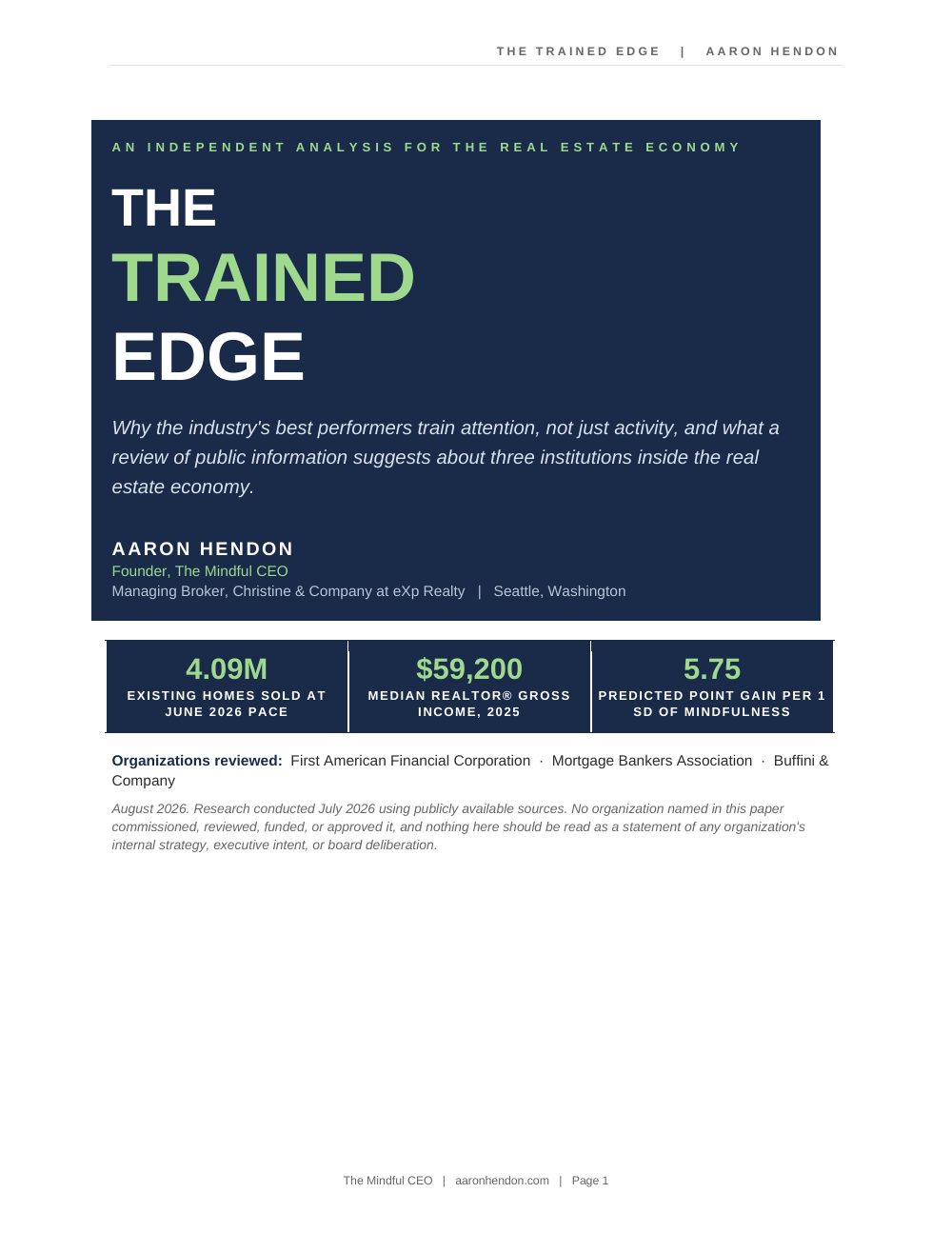
Why the industry's best performers train attention, not just activity, and what a review of public information suggests about three institutions inside the real estate economy.
AARON HENDON
Founder, The Mindful CEO
Managing Broker, Christine & Company at eXp Realty | Seattle, Washington
4.09M | $59,200 | 5.75 EXISTING HOMES SOLD AT |
JUNE 2026 PACE
MEDIAN REALTOR® GROSS
INCOME, 2025
PREDICTED POINT GAIN PER 1
SD OF MINDFULNESS
Organizations reviewed: First American Financial Corporation · Mortgage Bankers Association · Buffini &
Company
August 2026. Research conducted July 2026 using publicly available sources. No organization named in this paper commissioned, reviewed, funded, or approved it, and nothing here should be read as a statement of any organization's internal strategy, executive intent, or board deliberation.
THE TRAINED EDGE
|
AARON HENDON
CONTENTS
Executive Summary .................................................................................................................................... 3 How to Read This Paper ............................................................................................................................. 4 1. The Pressure Economy ......................................................................................................................... 5 2. The Wrong Diagnosis ............................................................................................................................ 7 3. What the Measurement Actually Shows .............................................................................................. 9 4. Three Organizations, Viewed From the Public Record .................................................................... 12 4.1 First American Financial Corporation .................................................................................................... 13 4.2 Mortgage Bankers Association.............................................................................................................. 14 4.3 Buffini & Company................................................................................................................................. 15 5. The Protocol: Five Trainable Spaces ................................................................................................. 16 6. Why Format Beats Content ................................................................................................................. 18 7. What This Suggests for Ecosystem Leaders .................................................................................... 21 Methodology, Sources, and Limitations ....................................................................................................... 24 About the Author .......................................................................................................................................... 27
THE TRAINED EDGE
|
AARON HENDON
EXECUTIVE SUMMARY
By the National Association of REALTORS® own description, the residential housing market has endured more than three years of sluggish sales, with existing-home sales hovering just above four million annually, the slowest pace since 1995. Median REALTOR® gross income was $59,200 in 2025. NAR membership stood at 1,439,163 as of June 18, 2026, down from 1,463,352 a year earlier and off a 2022 peak of roughly 1.5 million. Median member tenure rose to 13 years. Every institution in this ecosystem, brokerages, lenders, title companies, trade associations, and coaching organizations, has responded to that pressure with some combination of three levers: more technology, more lead volume, more training on tactics. None of those levers is wrong. The argument of this paper is that they may be incomplete, because each addresses what the professional does. The research reviewed here suggests that a meaningful share of performance variance under pressure sits somewhere else: in what the professional can hold onto while doing it. Pressure is often described as the great equalizer. The research reviewed here points the other way. Pressure appears to function as a revealer, widening the gap between those who trained and those who did not. This paper advances four propositions. Each is stated as a proposition rather than a finding, and each is followed in the body by the evidence supporting it and the limits of that evidence. ▪ One. The ecosystem may be treating a training problem as a character problem. Burnout, a listing presentation that comes apart, and a deal lost in the last quarter mile are commonly read as failures of grit. The evidence reviewed here suggests they can also be read as untrained attention operating under load. Notably, the pattern shows up at both ends of the career: among top producers carrying the largest books, and among newer agents who leave the business before the investment in them has compounded. ▪ Two. Attention is measurable. In a 2009 study of NCAA Division I basketball players, competitive free throw percentage sat nearly thirteen points below practice percentage, and measured mindfulness significantly predicted the size of that individual gap. Consistency of pre-shot routine did not predict it. The sample was seventeen players, which is small. ▪ Three. The effect appears outside sport. A 2019 pilot randomized trial at UCSF reported that surgical residents who trained for eight weeks held or improved cognitive control while the untrained control group's declined. A Fortune 100 insurer put more than 13,000 employees through attention training and reported 62 minutes of recovered weekly productivity per participant, on internal self-reported data. ▪ Four. Delivery format appears to matter more than content. Real-world 30-day retention for meditation apps has been measured at roughly five percent in panel-based research, while attrition in supported, structured trial conditions runs materially lower. That gap is itself the argument for format.
Section 4 reviews three organizations inside this ecosystem using only publicly available information:
First American Financial Corporation, the Mortgage Bankers Association, and Buffini & Company. They were selected because their public records are unusually well documented, and because together they occupy the three structurally distinct positions any capability travels through in this
THE TRAINED EDGE
|
AARON HENDON
industry. The observations offered about each are the author's interpretation of public material, not claims about internal decisions.
THE CORE PROPOSITION OF THIS PAPER
Every organization in the real estate economy trains its people on process, product, compliance, and technology. Based on the publicly published curricula reviewed for this paper, few appear to train the capacity that governs how those four perform when the stakes are highest. As the research summarized in Section 3 indicates, that gap is better understood as a performance gap than as a wellness gap, and it is measurable.
HOW TO READ THIS PAPER
This paper mixes three different kinds of statement. It is worth separating them at the outset so a reader can weigh each appropriately.
TYPE OF
STATEMENT
HOW IT IS SOURCED
HOW TO WEIGH IT
Verified fact Traceable to a primary source: a peer-reviewed paper, an SEC-reporting company's own release, a trade association's published materials, or an association's own research report. Treat as established, subject to the limits noted alongside it.
Company-reported
figure Published by the organization itself and not independently audited. Labeled as such everywhere it appears. Treat as directional. Useful for magnitude, not for precision.
Observation or
interpretation The author's reading of the above. Introduced with language such as this suggests, viewed through this lens, or appears to. Treat as one informed reading among several possible readings.
ON THE ORGANIZATIONS REVIEWED IN SECTION 4
Everything stated about First American Financial Corporation, the Mortgage Bankers Association, and Buffini & Company is drawn from public sources. Public announcements, awards, published curricula, and leadership changes are matters of record. They are not windows into executive reasoning or board deliberation, and this paper does not treat them as such. Where the author draws an inference about what a public record may indicate, that inference is labeled as an observation. Any of these organizations may operate internal programs, priorities, or plans that are not publicly disclosed. The absence of public evidence is not evidence of absence. One further note on the research itself. The studies cited in Section 3 are correlational and experimental in roughly equal measure, and several have small samples. Where a study demonstrates association rather than causation, that distinction is preserved in the text. The direction of the evidence across studies is reasonably consistent. The magnitude of the effect in any one organization is not predictable from this literature, and this paper does not attempt to predict it.
THE TRAINED EDGE
|
AARON HENDON
1 THE PRESSURE ECONOMY
The market numbers are usually reported as a housing story. Read alongside the workforce data published by the same association, they also describe an operating condition. For June 2026, NAR reported existing-home sales at a seasonally adjusted annual rate of 4.09 million, with a median sale price of $440,600 and 4.6 months of inventory. Chief Economist Dr. Lawrence Yun attributed month-to-month movement to mortgage rate fluctuations and buyer sensitivity to affordability. In April 2026, NAR revised its own 2026 forecast downward, trimming expected existing-home sales growth to 4 percent and moving new-home sales to flat, citing the upward trajectory of mortgage rates. The member data sits underneath that. NAR's 2026 Member Profile, drawn from more than 5,000 surveyed members reporting on the 2025 transaction year, records the following: ▪ Median years of experience rose to 13, up from 12 in 2024. About a quarter of members report more than 25 years. Members with less than one year of experience made up 11 percent of membership, up slightly from 10 percent. Median member age is 57. ▪ Median gross income from real estate reached $59,200, up from $58,100. Members with 16 or more years of experience reported a median of $88,500, up from $78,900. ▪ The typical individual agent had nine transaction sides, with a median sales volume of $2.7 million for brokerage specialists. Agents with six or more years reported a median of ten sides and about $3 million. ▪ Median business expenses rose to $9,530 from $8,010, with vehicle costs the largest category. ▪ The typical member earned 28 percent of business from past clients and customers, up from 20 percent. Among members with more than 16 years of experience, repeat business represented about half of the pipeline. ▪ Seventy-five percent of members said they were very certain they would remain active for at least two more years, up from 74 percent. Another 17 percent said somewhat certain, and 8 percent were unsure.
THE TRAINED EDGE
|
AARON HENDON
Figure 1. Between 2024 and 2025, the median gain for all members was roughly $1,100. For members with sixteen or more years of experience it was roughly $9,600. Both figures are NAR medians for self-reported gross income from real estate activities. One reading of these numbers NAR's deputy chief economist, Jessica Lautz, characterized the pattern as a more seasoned industry leaning on referrals, repeat clients, and deep market knowledge, and noted that the market has been operating under suppressed conditions for more than three years while the typical member has continued to gain experience and stay committed to the profession. That is the association's framing, and it is well supported by its own data. A second reading sits alongside it, and this paper is interested in the second one. Viewed as a workforce rather than as a market, this is a population in which the income gain has concentrated heavily among the most tenured members, median expenses rose by more in dollar terms than median income did, and roughly a quarter of members are not fully certain they will still be doing this in two years. It is worth being careful here. The data does not show that new entrants have disappeared: the share with under a year of experience actually rose slightly, from 10 to 11 percent. What the data does show is that the returns to the work are increasingly concentrated in tenure, and that tenure is built from relationships accumulated over years and sustained through exactly the conditions described above. A market this suppressed does not primarily test skill. Most of the people still standing after three years have the skill. What it appears to test is what the skill is running on.
THE CENTRAL OBSERVATION OF THIS ANALYSIS
The ancillary verticals draw from the same transaction count The pressure is not confined to the brokerage. Mortgage originators, title and settlement professionals, and insurance producers derive income from the same closings. When the count falls,
THE TRAINED EDGE
|
AARON HENDON
compensation tends to fall with it, while operating tempo does not necessarily fall at all. The file still has to be processed. The problem still surfaces at six o'clock on a Friday. Those verticals also carry something residential brokerage frequently does not: institutional employment. A title operations manager and a loan officer typically sit inside an organization with a profit and loss statement, a retention number, and a leadership team accountable for both. That structural difference matters for what follows, because it means an intervention of the kind this paper describes has an identifiable owner and budget. In the independent-contractor model that governs most residential brokerage, it often does not.
2 THE WRONG DIAGNOSIS
Ask a managing broker, sales manager, or branch leader why a capable producer came apart in a hard quarter, and the answers tend to cluster. They lost their discipline. They stopped prospecting. They got in their own head. They did not want it enough. The author's experience across three decades of training, thirteen years in the real estate industry, and nine years as a managing broker is that these explanations locate the failure in the person's character, and that the prescription which follows is usually more of the same input: more accountability, more activity, a tighter morning routine, a harder conversation. That is an observation from the field rather than a measured finding, and it should be weighed as one. It is stated here because it is the assumption the rest of this paper is arguing with. There are two patterns worth naming here, and most leaders in this industry will recognize both without needing a study to confirm them. They sit at opposite ends of the career, and either one is expensive enough on its own to justify the attention this paper is asking for. Which one costs a given organization more will depend on the shape of that organization: the size of the roster, the mix of veterans and new licensees, the average book carried by the top quartile, and what the business spends to bring a new agent to competence. This paper does not presume to make that calculation. It only asks that both be counted. The first pattern is at the top of the roster. The people who burn out are not only the marginal producers, they are often the top producers. The person carrying the largest book, taking the hardest files, and answering at nine on a Sunday is the person most likely to come apart, and they are also the most expensive person in the organization to lose. The cost of that loss is not only the production that walks out the door. It is the referral network built over a decade, the repeat clients who followed the person rather than the brand, the files in flight that have to be reassigned midtransaction, and in some cases the two or three other agents who leave in the following year because the departure changed what the office felt like. This is a field observation rather than a measured finding, but it aligns with the direction of the research in Section 3, which suggests the differential between trained and untrained attention widens as the load increases. The second pattern is at the front of the career, and it might be missed because it does not look like a crisis when it happens. It looks like ordinary attrition. A new agent is recruited, licensed, onboarded, mentored, given a technology stack, enrolled in the office's marketing, and coached through the first difficult transactions. Somewhere between month six and month eighteen, before the investment has compounded into a self-sustaining producer, the agent leaves the business. Every organization will price this differently, and a thorough calculation should include recruiting, licensing support, onboarding hours, mentorship time, technology seats, marketing enrollment, and
THE TRAINED EDGE
|
AARON HENDON
the manager hours spent coaching deals line by line through the first year. Whatever that number is inside a given business, the cost is paid again on the next hire, and the one after that, until the underlying skill the agent needed is taught rather than assumed. That skill is not prospecting scripts, CRM discipline, or contract knowledge, all of which are trainable inside a quarter. It is the ability to regulate attention under load, without which the nervous system runs the career on threat response and eventually concludes that the business is not for them. Both patterns point at the same underlying mechanism, at different points on the curve. The veteran and the new agent are not failing for different reasons. They are failing for the same reason under different loads. The private bargain Underneath the industry's default prescription sits a specific belief, and it is widely held at both ends of the career. The belief is that anxiety is the engine. That "dread avoidance" produces discipline, and that turning down the dread would turn down the output. It is voiced in respectable forms: "I run on stress," "I work better under pressure," "I need a little fear to do my best work." New agents often inherit the belief from the veterans who trained them, which is part of why both patterns persist inside the same organizations. The fear is real. The mechanism, as the underlying neuroscience is generally understood, does not appear to work the way the belief assumes. Anxiety is threat-avoidance processing running without a stand-down signal. It is genuinely useful for certain tasks. It will prompt a second read of the contract. It is not the system that closes a complex negotiation, holds composure while a seller cries at the kitchen table, or decides in nine seconds whether to concede a point. That work draws on executive function, and at least one controlled pilot summarized in Section 3 found executive function degrading, not improving, under sustained professional load. The clearest way to describe what actually goes wrong is borrowed from golf. Grip the club too tightly and everything downstream of the grip fails. The swing shortens, the tempo breaks, and the ball goes somewhere the player did not intend. Nobody grips too tightly because they stopped caring. They grip too tightly because the shot matters. The same mechanism operates in a negotiation, a listing presentation, a file that is coming apart on the day before closing, and the first cold call a new agent makes to a stranger. Without the tools to regulate under load, people tighten at precisely the moment the work requires them to stay loose. The tightening is not a failure of will. It is what an untrained nervous system does by default.
THE PROPOSITION, STATED PLAINLY
The engine many people in this business believe they are running on may not be the engine they are actually running on. Anxiety appears to function as acceptable sprint fuel and poor marathon fuel. At the top of the roster, the wear over a decade is visible in ways most leaders in this industry will recognize: cynicism, the third drink, the second marriage, the deal that came apart in the last quarter mile because the person running it had nothing left. At the front of the career, the wear is visible as attrition: new agents who leave the business before the training investment has a chance to compound. Attributing any individual case to this mechanism would be speculation. Noticing the pattern, at both ends of the career, is not.
THE TRAINED EDGE
|
AARON HENDON
What the published curricula cover For this paper the author reviewed publicly available continuing education catalogs, brokerage onboarding outlines, and national convention agendas across the residential and real estate finance verticals. The categories are consistent: contracts and compliance, technology and lead conversion, market data and pricing, negotiation tactics, personal branding, and business planning. All of it is useful, and all of it trains for the recurring parts of the job. Across the publicly published curricula reviewed, the author found little content addressing the capacity to sustain attention under acute pressure as a trainable skill in its own right. That is a statement about what is published, not about what any individual organization may deliver internally, informally, or through channels that are not publicly catalogued.
WHAT THE PUBLISHED
CURRICULA COVER
WHAT THAT APPEARS TO
PRODUCE
WHAT THE AUTHOR DID NOT
FIND ADDRESSED
Contracts and compliance Fewer errors, lower liability Performance when the file is already on fire Technology and lead conversion More top-of-funnel volume Sustaining attention through the conversation itself Negotiation tactics A better script Whether the script survives an unscripted emotional moment Business planning A clear target Whether capacity will still be present in month seven The proposition is that this is a training gap rather than a wellness gap and is. one plausible explanation for why it persists is categorical. Mental training was filed under wellness at some point over the last two decades, and in a sales culture wellness tends to read as optional. Notably, the most competitive results-driven organizations in the world appear to have made a different filing decision. Section 3 examines what they pay for and what their filing produces.
3 WHAT THE MEASUREMENT ACTUALLY SHOWS
In October 1993, at Phil Jackson's invitation and on a referral from Jon Kabat-Zinn, founder of the Mindfulness-Based Stress Reduction program at the University of Massachusetts Medical Center, a mindfulness teacher named George Mumford began working with the Chicago Bulls. Michael Jordan has credited Mumford with transforming his on-court leadership. Shaquille O'Neal later described him as the Lakers' secret weapon. Jackson, who has won more NBA championships as a head coach than anyone in league history, worked with Mumford across more than two decades and three organizations. Steve Kerr, who learned meditation from Mumford as a Bulls player and later coached the Golden State Warriors, has spoken publicly about continuing to lean on Mumford, including through a period of chronic pain during his coaching career. Stronger versions of this story circulate widely. The author was not able to verify them to a primary source and therefore does not repeat them here. What can be said without interpretation is narrower and, for a business audience, more useful. The most results-obsessed organizations in professional sport have been paying for mental performance staff for more than three decades. That is a spending pattern, and spending patterns in win-or-lose-
THE TRAINED EDGE
|
AARON HENDON
your-job environments are reasonable evidence of perceived return, though not proof of actual return. The number worth putting on a sales manager's wall In 2009, Amy Gooding and Frank L. Gardner published a study in the Journal of Clinical Sport Psychology examining the relationship between measured mindfulness and competitive free throw shooting among NCAA Division I men's basketball players. Trait mindfulness was measured with the Mindful Attention Awareness Scale before the season began. Free throws were then counted from game film across the full regular season. ▪ The headline finding. A one standard deviation increase in measured mindfulness predicted a 5.75 percentage point increase in game free throw percentage. Not practice percentage. Game percentage. ▪ The pressure gap. Players averaged 80.71 percent in practice and 67.84 percent in games. Same players, same skill, same rim. ▪ The discriminating variable. Mindfulness significantly predicted the size of the gap between an individual player's practice and game performance. Length and consistency of pre-shot routine did not predict game performance at all. Figure 2. The competitive drop in this sample was not a skill deficit. Every player could already shoot. What predicted the size of the individual drop was measured attention, not ritual. The limits of that study, stated plainly Three caveats belong with the finding, and a reader is entitled to all of them. ▪ Sample. Forty-three players completed the measures. Seventeen met the inclusion threshold of thirty or more competitive attempts and form the basis of the analysis. Seventeen is a small sample, and effects estimated from small samples carry wide uncertainty. ▪ Design. This is a correlational design. It establishes that measured mindfulness predicted game performance in this group. It does not establish that training mindfulness would have
THE TRAINED EDGE
|
AARON HENDON
caused improvement in these players. The authors framed the training implication as an inference for future research, not as a demonstrated result. ▪ Shared variance. When the researchers controlled for year in school, mindfulness and competitive experience shared explanatory variance and both lost individual significance. That is a real limitation. It is also, arguably, the more interesting result for anyone managing a sales force, because it raises the possibility that part of what the industry calls seasoning is accumulated attentional skill rather than unrepeatable biography. That possibility is a hypothesis, not a finding. Translating the unit Nobody in this ecosystem shoots free throws, but most people in it carry a metric that behaves similarly: listing appointments to signed agreements, applications to closings, quoted files to captured files, renewal conversations to renewals. A gain of the magnitude reported in that study, applied to any of those lines, would exceed what many organizations achieve from any single initiative in a year. Whether it would transfer at that magnitude has not been tested in this industry. That is the honest state of the question, and it is the reason the recommendation in Section 7 is a measured pilot rather than a rollout. Entire businesses are optimized around fractions of six points. If even part of that effect transfers, it is worth the size of a pilot. Evidence outside the arena
SURGERY
Carter C. Lebares and colleagues at the University of California, San Francisco published a pilot randomized clinical trial in JAMA Network Open in 2019 involving 21 first-year surgery residents. Residents completing a modified eight-week mindfulness-based stress reduction course showed higher mindfulness, lower stress, better executive function scores, faster motor skills, and distinct neural activation during an emotional regulation task, with effect sizes the authors described as medium to large. The authors also flagged a decrement in cognitive control scores within the control group, noting it raises the concern that the rigors of residency training may cause relative cognitive impairment over time. This was a pilot with 21 participants, explicitly framed by its authors as supporting the value of larger and more definitive trials rather than as a settled result.
ENTERPRISE SCALE
Aetna, under then-CEO Mark Bertolini, put more than 13,000 of roughly 50,000 employees through mindfulness and yoga programs. The company reported participants regaining an average of 62 minutes of productive time per week, valued at approximately $3,000 per employee per year, with an average 28 percent reduction in reported stress, 20 percent improvement in sleep quality, and 19 percent reduction in reported pain. Bertolini has publicly cited an eleven-to-one return. These are company-reported figures drawn from internal, largely self-reported data rather than independent audit. Bertolini himself noted publicly that the company's healthcare cost reductions over the same period reflected a set of programs rather than mindfulness alone. Read as directional rather than precise, the figures still describe an intervention with an unusually favorable cost structure.
THE TRAINED EDGE
|
AARON HENDON
Figure 3. Company-reported outcomes from a large-employer program. Self-reported internal data, presented as directional. Not independently audited.
THE PREVALENCE OBSERVATION
Tim Ferriss, who has interviewed several hundred performers across sport, business, investing, and the military, has written that the most common habit among them, by his count present in more than 80 percent, is some form of mindfulness practice. This is an author's observation across a selfselected interview set, not a survey with a defined sampling frame, and it should not be read as one. It answers a narrower question: whether this practice is rare among people operating at the top of demanding fields. It does not appear to be. WHAT THE BODY OF EVIDENCE SUPPORTS, AND WHAT IT DOES NOT Reasonably supported: Measured and trained attention is associated with better performance under competitive pressure, appears to protect executive function under sustained load in at least one controlled pilot, and shows its largest differential when stakes are highest. Not established here: That any of this eliminates stress, substitutes for skill, guarantees an income outcome, or produces a specific effect size in a real estate organization. Several of the studies cited are small or correlational. The direction across studies is reasonably consistent. The magnitude in any single organization has not been measured and is not predicted here.
4 THREE ORGANIZATIONS, VIEWED FROM THE PUBLIC
RECORD
The argument to this point is analytical. This section is observational, and its limits should be stated before anything else.
THE TRAINED EDGE
|
AARON HENDON
SCOPE AND LIMITS OF THIS SECTION
Everything below is drawn from publicly available information: company press releases, published association materials, organizational websites, and contemporaneous trade press. Research was conducted in July 2026. Public information describes what an organization has said and done in public. It does not reveal executive intent, board deliberation, internal strategy, or programs that exist but are not publicly described. Each profile below separates verified facts from the author's observations, and the observations are labeled as such. None of these organizations participated in, reviewed, funded, or approved this analysis. Corrections are welcomed and will be reflected in future versions. These three were selected on four criteria: each occupies a structurally distinct position in the real estate economy, each has a well-documented public record, each has made some public commitment relevant to the argument of this paper, and none competes directly with the author's brokerage. That last criterion is disclosed because it affects selection.
POSITION
ORGANIZATION
WHY THIS POSITION MATTERS STRUCTURALLY
The Enterprise
First American Financial
Corporation
Operates transaction infrastructure and employs the people who run it. Has publicly reported workplace culture recognition for over a decade.
The Trade Body
Mortgage Bankers
Association
Publishes the professional development curriculum for an entire vertical and convenes its leadership several times a year.
The Amplifier
Buffini & Company
Reaches practitioners directly at scale, and states quality of life as an explicit outcome of its programs.
4.1 First American Financial Corporation
Santa Ana, California · NYSE: FAF · Title, settlement, and risk solutions
WHAT THE PUBLIC RECORD SHOWS
First American is among the largest providers of title insurance and settlement services in the United States. The company reported total revenue of $7.5 billion in 2025 and describes a corporate history of more than 135 years. Mark E. Seaton was appointed Chief Executive Officer in April 2025, having joined the company in 2006 and served as Chief Financial Officer since 2013. Matt F. Wajner was promoted to Chief Financial Officer and Dennis J. Gilmore moved to Executive Chairman in the same announcement. In April 2026, Fortune and Great Place To Work named First American one of the 2026 Fortune 100 Best Companies to Work For. Per the company's release, this was the eleventh consecutive year it has appeared on that list. The company also reported that in 2025 it marked a decade among the Fortune Best Workplaces for Women and a ninth consecutive year among the Best Workplaces in Financial Services and Insurance, and that it has earned a top score on the Human Rights Campaign Foundation's Corporate Equality Index seven times.
THE TRAINED EDGE
|
AARON HENDON
This recognition underscores the enduring strength of our culture and the shared commitment of our people. MARK E. SEATON, CEO, FIRST AMERICAN FINANCIAL CORPORATION, APRIL 1,
2026 OBSERVATION (AUTHOR'S INTERPRETATION OF PUBLIC INFORMATION) |
Viewed through a culture-investment lens, an eleven-year unbroken run on the Fortune 100 Best list suggests a commitment that has been sustained across a housing boom, a rate shock, a sustained transaction downturn, and a chief executive transition. That is a longer horizon than most single-cycle initiatives survive. What the public record does not disclose is what that commitment costs, how the budget is allocated, or what proportion of it addresses performance under acute pressure as distinct from the broader conditions of employment. Those are internal matters, and nothing here should be read as knowledge of them. A narrower question follows from the public information: workplace recognition of this kind generally measures the conditions around the work. The research in Section 3 concerns what happens inside the highest-stakes minutes of it. Those appear to be complementary rather than substitutable, and from the publicly available information the second is the less commonly instrumented of the two, at this company and across the industry.
A COMMERCIAL OBSERVATION
Title and settlement organizations convene real estate agents regularly through continuing education and agent-facing events. Based on publicly posted event agendas across this category, that content is predominantly transactional and market-focused. Viewed through a differentiation lens, an organization with a documented eleven-year culture record may be unusually credible bringing a different category of content into the same room. Whether that is of interest to this particular company is not something the public record answers.
4.2 Mortgage Bankers Association
Washington, D.C. · The national association representing the real estate finance industry
WHAT THE PUBLIC RECORD SHOWS
MBA represents the real estate finance industry in Washington and publishes much of the professional development curriculum for the vertical. Robert D. Broeksmit, CMB, has served as President and Chief Executive Officer since 2018, following senior mortgage lending roles including fourteen years with Chevy Chase Bank and its B.F. Saul Mortgage subsidiary. Christine Chandler serves as 2026 Chair. Owen V. Lee, Chief Executive Officer of Success Mortgage Partners, serves as 2026 Chair-Elect. John Hedlund of ICE Mortgage Technology serves as Vice Chairman. The association's published programs include the School of Mortgage Banking, the Certified Mortgage Banker designation, the Annual Convention and Expo, the Independent Mortgage Bankers Conference, and mPower, its network for women in real estate finance. Membership, meetings, and mPower sit under a single senior vice president, Laura Hopkins, AMP. The association has also run a CEO Listening Tour taking leadership into regional markets, including a Detroit stop in 2026.
THE TRAINED EDGE
|
AARON HENDON
WHY THE ASSOCIATION POSITION IS STRUCTURALLY DISTINCT
A brokerage trains its own agents. A lender trains its own originators. An association publishes what counts as professional development for an entire vertical at once. Historically in this industry, capabilities that moved from optional to standard, compliance and fair lending among them, moved through associations and designations. That is a pattern in the public record rather than a claim about how this particular association makes decisions.
OBSERVATION (AUTHOR'S INTERPRETATION OF PUBLIC INFORMATION)
The publicly described MBA education architecture is organized around technical competence: underwriting, secondary markets, servicing, capital markets, and compliance. Reviewing the publicly posted curriculum descriptions and conference agendas, the author did not find content addressing sustained attention or performance under acute pressure as a trainable skill. That observation describes what is published. It does not establish what is delivered in every session, what individual member companies provide internally, or what the association may be considering. A professional who has completed a technical pathway knows the file. Whether anything in that pathway is designed to address how the knowledge performs in the eleventh month of a hard year is a question the public curriculum does not answer either way. One further structural note: lenders and title companies convene real estate agents regularly and are generally brand-agnostic about which brokerage those agents belong to. Viewed through a distribution lens, that makes the finance side of the industry one of the few settings where the whole ecosystem is in the same room.
4.3 Buffini & Company
Carlsbad, California · Described by the company as North America's largest real estate coaching and training company
WHAT THE PUBLIC RECORD SHOWS
Brian Buffini emigrated from Dublin to San Diego in 1986, became a top-producing real estate agent, and founded Buffini & Company in 1996. In January 2026, after thirteen years as Chief Executive Officer, Dermot Buffini announced he would step down, moving to board advisor and international brand ambassador. Brian Buffini took on the roles of Chairman and Chief Executive Officer. The following are company-reported figures published by Buffini & Company or reported in contemporaneous trade press, and are not independently audited: the company states it has worked with more than four million professionals across more than 45 countries over 30 years; that its One2One Coaching Members earn an average of $369,400; and that the founder's podcast, It's a Good Life, has more than 24 million listeners across 178 countries. Buffini & Company introduced a Certified Full-Service Professional designation in 2024, and both Brian and Dermot Buffini have been named Inman Power Players.
A CONSISTENT THREAD IN THE COMPANY'S OWN LANGUAGE
Across the company's published descriptions of its programs, one phrase recurs: improve their business, increase net profit, and enhance their quality of life. The company also describes the founder's stated mission as inspiring a global community of professionals to live the good life. This is a matter of published record, and it has been consistent in the company's language for many years.
THE TRAINED EDGE
|
AARON HENDON
Viewed through a positioning lens, an organization that has placed quality of life alongside net profit for three decades has already made the argument this paper is making. What mechanism delivers it is a separate question, and one the public record does not answer.
OBSERVATION (AUTHOR'S INTERPRETATION OF PUBLIC INFORMATION)
Coaching organizations at scale operate on accountability against a system, and any program of that kind produces both strong results among clients who execute it and attrition among those who do not. That is a general characteristic of the model rather than a comment on this company's retention, which is not publicly disclosed. In the author's experience of industry discourse, that attrition is commonly attributed to client commitment. The research in Section 3 raises the possibility that some share of it reflects capacity rather than commitment, and that capacity may respond to training that tactical content does not address. That is a hypothesis about a mechanism, not a claim about any specific organization's clients. Commercially, the distinction matters: attention training would sit alongside a lead generation or business system rather than compete with it. It is plausibly an input to execution rather than an alternative to it. Whether that proves out is testable, and Section 7 describes how. THE PATTERN ACROSS ALL THREE, AND WHAT IT DOES NOT TELL US First American has publicly reported culture recognition for eleven consecutive years. MBA publishes the professional development curriculum for an entire vertical. Buffini & Company has stated quality of life as a program outcome for three decades. Each of those is a verified fact. From the publicly available information, the author found no publicly described program at any of the three that trains attention as a measurable performance skill in the specific sense described in Section 5. That is a statement about the public record only. Any of these organizations may have relevant internal work underway, and the absence of public evidence is not evidence of absence. Read as an opening rather than as a criticism, that gap is the reason this paper exists.
5 THE PROTOCOL: FIVE TRAINABLE SPACES
A diagnosis without a protocol is commentary. What follows is the working sequence the author teaches, stated plainly enough to be evaluated on the merits. It is presented as a practitioner's method with a track record in cohort delivery, not as a clinically validated intervention. It has not been tested in a controlled trial, and it should not be confused with the studies described in Section
3. There are five spaces and they run in order. They are not phases to complete and leave behind. |
They are positions to move through deliberately until the path is worn in and available under pressure. In the author's experience across cohorts, the order matters: attempting a later space before an earlier one is the most common reason participants conclude the work does not function for them.
THE TRAINED EDGE
|
AARON HENDON
Figure 4. The Five A's. The daily practice requirement is roughly ten minutes, which is materially less time than most professionals will spend scrolling on their phone today.
1. Awareness
Awareness is the floor. It is the act of noticing what is actually happening, in the body, in the mind, and in the room. Most professionals, most of the time, are running scripts, pattern-matching the present onto the past, and mentally rehearsing the next call while half listening to this one. You know you were not aware when you finish a listing appointment and could not, under crossexamination, summarize what the seller actually said about why they are moving. That is not primarily a memory problem. It is an attendance problem. ▪ Where to start. Sixty seconds, once a day, is the entry ramp and not the destination. Sit. Notice the breath. Notice when the mind wanders, which it will. Bring it back. From there the practice builds toward the roughly ten minutes a day the full protocol asks for. The purpose is not relaxation. The purpose is to begin seeing your own mind.
2. Allowance
Once you begin seeing your own mind, the immediate impulse is to fix what you see. Suppress the unwanted thought. Rearrange the embarrassing emotion. Argue with the story. Allowance is the practice of letting the thing be exactly what it is, without fixing, fighting, or rearranging. This is not resignation. Resignation is giving up. Allowance is declining to spend energy arguing with something that has already happened. The listing already went to the other agent. The file already fell out. You can litigate it internally for three weeks, or allow that it happened and put the remaining energy on what comes next. ▪ Where to start. When a feeling you dislike shows up, name it. I am noticing frustration. I am noticing fear. That is the whole intervention. The naming does the work.
3. Acceptance
Allowance lets the thing exist. Acceptance formally admits it into the record. These are not the same, and the gap between them is where professionals get stuck for years. They will allow a difficult truth to be true, the pipeline is not what it looks like, the partnership is not working, the body is sending signals, and then hold it at arm's length in a kind of limbo where it has never been formally acknowledged. Acceptance is not approval, agreement, or endorsement. It is the internal admission that the thing is true, which appears to be the condition under which attention becomes available for what to do about it.
THE TRAINED EDGE
▪ |
AARON HENDON
Where to start. One question, out loud or on paper: what am I refusing to admit is true? The first answer will be defensive. Ask again. The second answer is the one.
4. Appreciation
This is not the silver lining question and it is not everything happens for a reason. Those are bypasses, and most experienced professionals can identify a bypass immediately and will reasonably reject it. Appreciation is the harder question: what is here that I have not noticed because I was busy fighting what is also here? Attention directed at something genuinely worth appreciating occupies the floor for that moment, and in the author's experience those moments accumulate into the texture of a person's experience. The difficult thing remains in the room, but it stops being the entire room. ▪ Where to start. Three specific things from the day, written down before sleep. Not categories. Not my family. Specific moments. The specificity is the entire technique.
5. Attitude
In aviation, attitude describes an aircraft's orientation in space. Not how high you are. Which way you are pointed. When the first four spaces have been worked, orientation tends to reorient with far less effort. Gratitude is less something to manufacture than what remains once resistance is removed. A cork does not work to reach the surface. You work to hold it under. Release the pressure and it rises. This is also, in the author's view, why most versions of be more grateful fail. Skipping to the fifth space produces the Live, Laugh, Love sign on the burning building. The sign might be technically accurate, but the building is still on fire. ▪ The weekly check. Once a week, one question. Not am I happy. Am I pointed somewhere I actually want to go. If yes, the work is working. If no, return to Awareness and begin again.
WHY THE SEQUENCE IS THE METHOD
You cannot accept what you have not allowed. You cannot appreciate what you have not accepted. You cannot hold a grateful orientation in a life you have never appreciated. Each space opens the next. In the author's cohort experience, participants who attempt the fifth space first tend to abandon the practice within about three weeks and conclude the work does not function for them. A more accurate conclusion is that they started at step four. This is a practitioner observation drawn from cohort delivery, not a controlled finding.
6 WHY FORMAT BEATS CONTENT
This is the finding most relevant to any organization considering this as a program rather than a personal practice, and it is the one most likely to be resisted, because the format the evidence favors costs more than the alternative. The proposition is that content is not the main variable. Delivery structure is.
THE TRAINED EDGE
|
AARON HENDON
Stated more sharply, and this is the author's own framing after years of watching people try: an app is a reasonable tool for maintaining a practice you already have. It is a poor tool for acquiring one you do not. The distinction sounds small and it decides almost everything about whether an organizational program works, because most people who conclude that this work is not for them reached that conclusion alone, on a phone, in the first month. What the retention research actually measures Two bodies of evidence bear on this, and they measure different things. Read together they are more useful than either alone.
REAL-WORLD USE
Baumel, Muench, Edan, and Kane published a systematic search and panel-based usage analysis in the Journal of Medical Internet Research in 2019, examining objective engagement with mental health apps among real-world users rather than trial participants. Across the apps studied, median 15-day retention was 3.9 percent and median 30-day retention was 3.3 percent. Mindfulness and meditation apps performed better than most categories at day 30, with a median retention of 4.7 percent, and had among the highest median daily minutes of use among those who stayed.
SUPPORTED AND STRUCTURED USE
Linardon and colleagues published a systematic review and meta-analysis of randomized controlled trials of mindfulness apps in Behaviour Research and Therapy in 2023. Across 9,258 participants allocated to a mindfulness app, the weighted attrition rate was 24.7 percent, rising to 38.7 percent when restricted to larger studies. The authors also reported that studies offering participants compensation and requiring in-person enrollment were associated with the lowest attrition rates, and noted clear problems with sustained engagement across the literature. WHAT THE GAP BETWEEN THOSE TWO NUMBERS APPEARS TO INDICATE Roughly 5 percent of real-world users are still practicing at 30 days. Roughly 60 to 75 percent of trial participants remain engaged, and the trials with the strongest enrollment procedures and human contact retained the most people. The content in both settings is broadly comparable. What differs is enrollment friction, accountability, and human contact. Viewed through that lens, the retention problem looks structural rather than motivational. This is an inference from two literatures that were not designed to be compared directly, and it should be weighed accordingly. Three mechanisms that plausibly drive solo drop-off ▪ The content repeats. After a period on any major platform, a user has heard the prompts they are going to hear. A library is not a curriculum. Without progression there is less felt progress. ▪ The relationship is one-way. A recording made for everyone cannot answer a specific question, notice that a practice has drifted, or push back when a practitioner is kidding themselves. ▪ The format can invite quitting. Engagement notifications designed to retain a user can begin to read as scolding. A skipped day produces a reminder, the reminder produces irritation, and disengagement follows.
THE TRAINED EDGE
|
AARON HENDON
These three are the author's reading of why the retention numbers look the way they do. They are consistent with the qualitative synthesis in the Linardon review, which flagged sustained engagement as a persistent problem, but they are not themselves separately measured findings. The intensive has the opposite failure mode The opposite of an app is a retreat. Four days, seven, ten, in a good location with a real teacher. Retreats are powerful and people describe them, sincerely, as life-changing. In the author's observation, the change commonly fades within weeks of returning. The spike is real, but spikes are not the same as durable capacity. Durable capacity appears to come from repeated low-intensity practice sustained long enough that the new behavior becomes default. An unrepeated intensive returned to an unchanged daily environment is competing with that environment on unfavorable terms.
FORMAT
WHAT IT DELIVERS
WHY IT APPEARS TO FAIL OR HOLD
App, solo Access, convenience, low cost Minimal curriculum, no relationship, no social cost to stopping Retreat, intensive A vivid experience of what is possible No repetition, and the daily environment is unchanged on return Live cohort, weekly Repetition, relationship, accountability Stopping becomes socially visible, which appears to be much of the mechanism Three structural ingredients recur wherever adults reliably acquire complex skills. It is live. It is regular. It includes other people who notice. That pattern holds for the gym, the writers' workshop, the surgical residency, and every professional designation this industry currently respects. Trained attention is not the exception to how complex skills are learned. On the available evidence it looks like an ordinary example of the rule.
THE CONFIGURATION THE AUTHOR RUNS
Nine weeks. One live session per week, one hour, by video. One short meditation practiced roughly ten minutes a day in between. A small group of peers also doing it and also reporting back. A teacher who is not a recording. Accountability that is structural rather than nagged. Sixty-three days of practice and nine guided conversations. The proposition is that the mechanism is not primarily the content. It is that when the people in your cohort will notice you did not show up, you show up. Completion rates in the author's cohorts have run materially above the real-world app retention figures cited above, though these are the author's own program records and have not been independently verified. One first-party application, disclosed as such The author ran this configuration inside his own brokerage, and the result is reported here because withholding it would be its own kind of distortion. It is also the weakest form of evidence in this paper, and it is labeled that way. The program ran from January 15 to March 2025, nine weeks, and all ten agents at Christine & Company took part: one live hour per week, roughly ten minutes of daily practice in between. Participation was voluntary. Over the first four months of 2024 the team closed ten transactions.
THE TRAINED EDGE
|
AARON HENDON
Over the first four months of 2025 it closed twenty-six, an increase of 160 percent. Those deal counts come from transaction records and are the one figure here the author can document. Five reasons not to treat that as a finding: ▪ Sample. Ten agents on one team. No control group, no matched comparison, and no randomization. ▪ Dual role. The author was both the managing broker and the instructor, which is the strongest single argument for discounting the result. ▪ Overlapping window. The program ran from January 15 to March 2025 and the comparison window is January through April. The measurement period therefore contains the training rather than following it. ▪ Market effects. Conditions differed between the two periods, and no attempt was made to separate that effect from the program's. It is worth noting that, per Northwest Multiple Listing Service data for King County, Washington, units sold across the wider market declined roughly 3 percent year over year across the same window, which does not appear to explain the increase, but no formal adjustment was made. ▪ Undocumented gains. The team also reported improvements in retention and referral volume. The author could not trace those to originating records, so they are excluded here under the same standard applied to every other claim in this paper. What this is: one uncontrolled application, in this industry, with a documented sales figure and an undocumented explanation. What it is not: evidence that the effect transfers at that magnitude anywhere else. It is offered as the reason a pilot is worth running, not as a substitute for running one.
7 WHAT THIS SUGGESTS FOR ECOSYSTEM LEADERS
The practical question is not whether trained attention improves performance in general. Section 3 addresses the direction of that evidence and its limits. The practical question is what a proportionate first move looks like from a specific seat, given that the effect size in this industry has not been measured. The recommendations below are the author's, offered as options to evaluate rather than as conclusions the evidence compels. In every case the recommendation is a measured pilot, because a pilot is what an untested effect size warrants. If you lead an enterprise inside the transaction ▪ You already measure engagement and culture. Consider adding one question that isolates the variable this paper concerns: can our people hold focus in the highest-stakes twenty minutes of their week? Standard engagement instruments are not designed to answer that. ▪ Consider a pilot in the function with the highest emotional load and the cleanest existing measurement, often escalations, closing, or a customer-facing sales team. Six to nine weeks, one cohort, pre and post measurement on a metric that team already reports. ▪ Where the program sits organizationally is likely to affect its budget, its sponsor, and whether senior people attend. The author's recommendation is to place it under performance rather than benefits, and to have an operator rather than a benefits administrator lead it.
THE TRAINED EDGE
▪ |
AARON HENDON
If you convene real estate agents through education events, the same content is a differentiated agenda item in a category where most sessions cover comparable market material. If you lead a trade association ▪ The leverage here is definitional. Historically in this industry, a capability that enters the published curriculum tends to shift from a personal choice toward a professional standard. That is a pattern in the record, not a prediction. ▪ The lowest-risk entry point is a single general session or workshop track at a national or regional convening, framed as performance under pressure rather than as wellbeing. ▪ A measurable version is a cohort offered to a defined member segment, with completion and self-reported performance tracked against the association's existing education benchmarks. If you lead a coaching or training organization ▪ Retention math in any accountability-based program contains a capacity variable that is rarely isolated. Some share of clients who stop executing a system may be depleted rather than uncommitted. That is a hypothesis worth testing, not an established fact. ▪ Attention training would run alongside a lead generation or business system rather than compete with it, which makes it comparatively low-risk to trial. ▪ The cleanest test is a cohort run alongside an existing program, comparing completion and renewal against a matched group receiving the tactical content alone. If you lead a brokerage ▪ The structural constraint is that you do not employ your producers and therefore cannot mandate participation. That is fine, because the work described here can only be offered on a voluntary basis in any case. It does make format the whole question. Optional, live, smallgroup, and recurring is the configuration with the strongest supporting evidence in a voluntary population. ▪ On the NAR data in Section 1 and the two patterns described in Section 2, the economics appear compelling at both ends of the roster. Tenured producers carry the revenue, have absorbed three suppressed years, and are the most expensive people in the building to replace. Newer agents who leave before the investment in them compounds cost the organization the full price of recruiting, onboarding, and mentoring them, paid again on the next hire. ▪ Most organizations in this industry distribute development spending evenly across the roster. The distribution of production is not even. If a fifth of the roster generates the majority of the revenue, and that same fifth is the group carrying the load described in Section 2, then a program aimed at everyone is aimed at the wrong people. Pilot it where the return on investment is highest in your organization.
THE TRAINED EDGE
THE
PERFORMANCE
|
AARON HENDON
BRIEFING
Eliminating high performer burnout A ninety-minute working session for your leadership team Not a talk about breathing. A structured review of where attention may be costing your organization measurable performance, which function to pilot first, what to measure before and after, and what a six-to-nine-week cohort looks like inside your operating calendar. Delivered live, on site or by video. ▪ Where a pressure gap may be showing up in your existing numbers ▪ Which team to pilot, and the metric to hold it to ▪ The six-to-nine-week format, the ten-minute daily requirement, and what it costs ▪ A speaking or workshop option for your next convening ▪ A version built for newer agents: launching a career with clarity, presence, and power Aaron Hendon | aaron@aaronhendon.com | 206-280-3312 | aaronhendon.com
THE TRAINED EDGE
|
AARON HENDON
METHODOLOGY, SOURCES, AND LIMITATIONS
Scope and research window Research for this paper was conducted in July 2026 using publicly available sources. Market and workforce data reflect the most recent releases available at that time. Organizational information in
Section 4 reflects the public record as of the same date and may have changed since. No
confidential, proprietary, or non-public information was used in the preparation of this paper. Source hierarchy Three tiers of evidence appear in this paper, and each is labeled where it is used. ▪ Tier 1, primary source. Peer-reviewed research, an association's own published research report, or an SEC-reporting company's own release. Stated as fact, with sample sizes and design limitations noted alongside. ▪ Tier 2, company-reported. Published by an organization about itself, not independently audited. Labeled as company-reported everywhere it appears and treated as directional rather than precise. ▪ Tier 3, observation. The author's reading of Tier 1 and Tier 2 material, or the author's practitioner experience. Introduced with explicit qualifying language and, in Section 4, set in labeled observation blocks. How the three organizations were selected ▪ Each occupies a structurally distinct position: enterprise, trade body, and amplifier. ▪ Each has a well-documented public record sufficient to support a profile without speculation. ▪ Each has made a public commitment or statement relevant to the argument of this paper. ▪ None competes directly with the author's brokerage, which removes one source of bias and introduces a selection constraint that readers should know about. No organization was contacted, and none participated in, reviewed, funded, or approved this analysis. Nothing in Section 4 should be read as knowledge of internal strategy, executive intent, or board deliberation.
Limitations
▪ Small samples. The central sport-performance study analyzed seventeen athletes. The surgical trial was a pilot with twenty-one residents. Effects estimated from small samples carry wide uncertainty and may not replicate. ▪ Correlation is not causation. The Gooding and Gardner study is correlational. It does not establish that training mindfulness causes performance improvement, and its authors did not claim that it did. ▪ Self-reported data. The Aetna figures and several organizational statistics in Section 4 are self-reported by the organizations concerned. Self-report inflates favorable outcomes in general and should be discounted accordingly. ▪ Published curriculum is not delivered curriculum. Statements in Sections 2 and 4 about what curricula do not cover describe publicly posted materials the author reviewed. Organizations may deliver content that is not publicly catalogued.
THE TRAINED EDGE
|
AARON HENDON
▪ No peer-reviewed study cited here was conducted in real estate, mortgage, or title. The single in-industry result reported in Section 6 is the author's own uncontrolled application inside his own brokerage, which carries the limitations listed alongside it. Whether the effects described in Section 3 transfer to this industry, and at what magnitude, remains untested by any independent design. This paper recommends measured pilots for that reason. ▪ Author's commercial interest. The author operates a commercial program in the subject matter of this paper and therefore has an interest in its conclusions. Readers should weigh the evidence rather than the author, which is why sample sizes, study designs, and source tiers are disclosed throughout. Claims considered and excluded The following statements are widely circulated in this subject area and were considered for inclusion. Each was excluded because the author could not trace it to a primary source. They are listed here so that readers encountering them elsewhere know they were examined. ▪ The claim that a scheduled accountability appointment produces a 95 percent goal completion rate. Commonly attributed to the Association for Talent Development or its predecessor. The figure circulates through secondary and tertiary sources with inconsistent supporting percentages, and no underlying published study was located. Excluded. ▪ The claim that solo online courses are completed by under 15 percent of enrollees while cohort versions exceed 85 percent. Widely repeated online. No primary publication supporting the specific figures was located. Excluded and replaced with the peer-reviewed app retention and attrition research cited in Section 6. ▪ The claim that Steve Kerr identified meditation as the single largest factor in his career. Not verifiable to a primary source. Section 3 states only what is documented: that Kerr learned meditation from George Mumford and has spoken publicly about continuing to work with him. ▪ Median income and transaction sides for agents with two years of experience or less. Reported in secondary trade coverage of the NAR Member Profile but not located in NAR's own published summary. Excluded from the text and from Figure 1, which uses only figures published directly by NAR. ▪ Reported improvements in worry and gratitude among the author's own program participants. Previously carried as an 80 percent reduction in worry and a 70 percent increase in gratitude. The author was unable to locate the originating response data, so both were removed rather than softened. The same standard was applied to the retention and referral figures described in Section 6.
Sources: industry and market data ▪ National Association of REALTORS®, 2026 Member Profile, published June 2026, reporting on the 2025 transaction year, based on more than 5,000 member responses. Source for tenure, age, income, expenses, transaction sides, repeat business, and retention intent figures. ▪ National Association of REALTORS®, membership figures as of June 18, 2026, as reported by the association at its 2026 legislative meetings.
THE TRAINED EDGE
|
AARON HENDON
▪ National Association of REALTORS®, Existing-Home Sales reports, April 13, 2026 and July 9, 2026, including commentary from Chief Economist Dr. Lawrence Yun and the association's revised 2026 forecast. ▪ Commentary from Jessica Lautz, NAR Deputy Chief Economist, as published by NAR, June 25, 2026. ▪ Northwest Multiple Listing Service, closed sales data for King County, Washington, first four months of 2024 against the first four months of 2025. Source for the year-over-year change in units sold cited in Section 6.
Sources: performance and clinical research ▪ Gooding, A., and Gardner, F. L. (2009). An Investigation of the Relationship Between Mindfulness, Preshot Routine, and Basketball Free Throw Percentage. Journal of Clinical Sport Psychology, 3(4), 303 to 319. Seventeen of forty-three NCAA Division I men's players met inclusion criteria. Mindfulness measured via the Mindful Attention Awareness Scale (Brown and Ryan, 2003). ▪ Lebares, C. C., Guvva, E. V., Olaru, M., Sugrue, L. P., Staffaroni, A. M., Delucchi, K. L., Kramer, J. H., Ascher, N. L., and Harris, H. W. (2019). Efficacy of Mindfulness-Based Cognitive Training in Surgery: Additional Analysis of the Mindful Surgeon Pilot Randomized Clinical Trial. JAMA Network Open, 2(5), e194108. Twenty-one first-year surgery residents, University of California, San Francisco. ▪ Baumel, A., Muench, F., Edan, S., and Kane, J. M. (2019). Objective User Engagement With Mental Health Apps: Systematic Search and Panel-Based Usage Analysis. Journal of Medical Internet Research, 21(9), e14567. Source for real-world 15-day and 30-day retention medians. ▪ Linardon, J., and colleagues (2023). Rates of attrition and engagement in randomized controlled trials of mindfulness apps: Systematic review and meta-analysis. Behaviour Research and Therapy. Weighted attrition of 24.7 percent across 9,258 participants, rising to 38.7 percent in larger studies. ▪ Jackson, P. Sacred Hoops (Hyperion, 1995) and Eleven Rings (Penguin, 2013). George Mumford's 1993 engagement with the Chicago Bulls and subsequent work with Jackson's teams as documented in contemporaneous interviews and trade coverage, including Tricycle and Mindful. ▪ Ferriss, T. Tools of Titans (2016). Author's observation on the prevalence of mindfulness practice among interviewed performers. Not a survey with a defined sampling frame. ▪ Christine & Company at eXp Realty, internal transaction records for the first four months of 2024 and 2025, and the author's own program documentation for the nine-week cohort that ran from January 15 to March 2025. First-party, uncontrolled, and not independently audited. See the limitations stated in Section 6. ▪ Aetna corporate mindfulness program outcomes as publicly reported by then-CEO Mark Bertolini and covered contemporaneously in the business and healthcare press. Companyreported, largely self-reported internal data, not independently audited.
THE TRAINED EDGE
|
AARON HENDON
Sources: organizations reviewed in Section 4 ▪ First American Financial Corporation. 2025 total revenue, corporate history, and 2026 Fortune 100 Best Companies to Work For recognition per company release dated April 1, 2026. Leadership appointments per company release dated April 15, 2025. ▪ Mortgage Bankers Association. Leadership, 2026 officers, education programs, designations, and convenings per the association's published leadership, governance, education, and conference materials, accessed July 2026. ▪ Buffini & Company. Founding, company history, scale figures, coaching member earnings, podcast audience, and designation per company published materials. The January 2026 chief executive transition per company announcement and contemporaneous trade press coverage. Scale, earnings, and audience figures are company-reported and not independently audited.
CORRECTIONS
If any organization named in this paper identifies a factual error, an outdated figure, or an observation that misrepresents its public record, the author will correct it and reissue. Corrections may be sent to aaron@aaronhendon.com.
ABOUT THE AUTHOR
Aaron Hendon eliminates high performer burnout. He works with high-performing professionals and sales teams to build the nervous system infrastructure that lets them direct their attention on purpose, under pressure, without losing their drive. He teaches mindfulness as performance training. Not therapy, and not woo. He is a Managing Broker with Christine & Company at eXp Realty in the Puget Sound region, a sixfigure agent for thirteen consecutive years, and a founder of a team named Five Star Real Estate Agents in Seattle for nine consecutive years. Before real estate he built and sold a community bakery in Albuquerque, growing it from one employee to forty and from no revenue to roughly a million dollars a year. For more than thirty years he has delivered leadership development programs for Landmark across the United States and Europe, training approximately 4,600 people in its leadership and customer service program and leading sales presentations to more than 6,500. He has written four books, including the Amazon number one new release Shortchanged by Shortcuts?, Sell Your Home Like a Boss, and, in 2026, How to Live a Grateful Life in a Fckd Up World, the manual for the nine-week cohort described in this paper. He runs three programs under The Mindful CEO: The Mindful Sales Method: The Art and Science of Not Selling, a seven-session program for experienced salespeople; the nine-week grateful life cohort; and The Mindful Agent, a practice set built for real estate professionals. He has been featured in Inman, Authority Magazine, NBC, CBS, FOX News, Yahoo Finance, and the Boston Herald.
THE TRAINED EDGE
|
AARON HENDON
REPORTED BY PROGRAM PARTICIPANTS
160% INCREASE IN CLOSED DEALS | 10 | 10 TRANSACTIONS, SAME FOUR |
MONTHS, 2024 TO 2025
AGENTS, ONE TEAM, NINE
WEEKS
Documented. Not typical. Christine & Company at eXp Realty, first four months of 2024 against the first four months of 2025, from the team's transaction records. The nine-week program ran from January 15 to March 2025. Ten agents, voluntary participation, no control group, and the author served as both managing broker and instructor. Reported in full, with its limitations, in Section 6. He lives on Vashon Island, Washington, with his wife of nearly thirty years. He is a Deadhead, a Seahawks season ticket holder, and, by his own account, a graduate of New York Jewish guilt with honors.
CONTACT
Aaron Hendon, Founder, The Mindful CEO
aaron@aaronhendon.com | 206-280-3312 aaronhendon.com | linkedin.com/in/aaronhendon thegratefulbreath.com | themindfulsalesmethod.com For a performance briefing, a speaking inquiry, or a pilot cohort discussion.
Download the full white paper
Get the PDF delivered to your inbox.