HUMANS: The Not-So-Secret Key to Retail Success in a Digital World
A profile of three voices converging on the same conclusion about the future of retail.
Jon Dario | JonDario.com
HUMANS
The Not-So-Secret Key to Retail Success in a Digital World A profile of three voices converging on the same conclusion about the future of retail.
Jon Dario
June 2026 Jon@JonDario.com | JonDario.com | @JonMDario HUMANS: The Not-So-Secret Key to Retail Success in a Digital World ·
1 / 14
Jon Dario | JonDario.com
Executive Summary
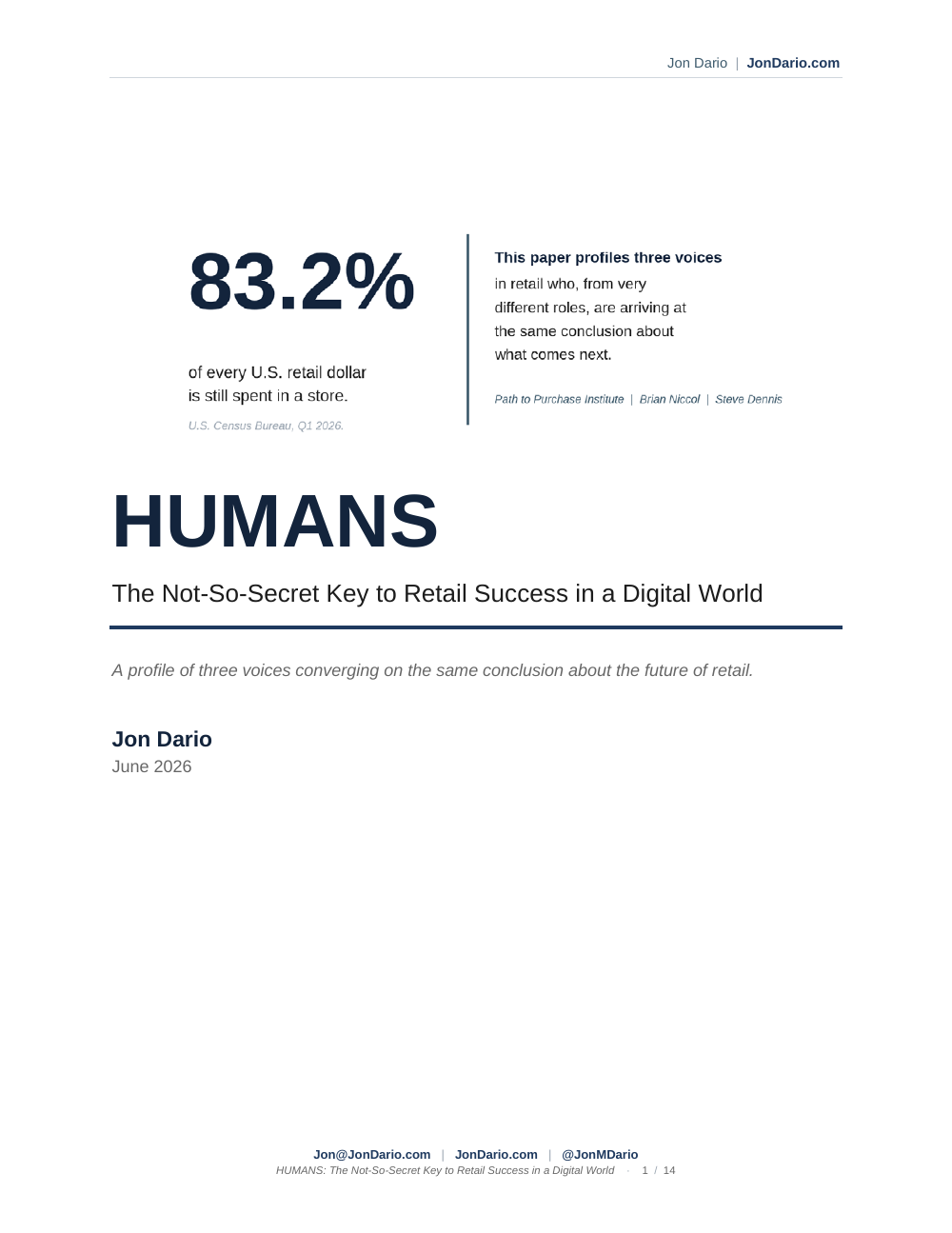
Roughly 83 cents of every retail dollar in the United States are still spent in a store. That is not a forecast. That is the latest reading from the U.S. Census Bureau: e-commerce accounted for 16.8% of total retail sales in the first quarter of 2026. After more than a decade of disruption, the digital share of retail has been climbing about one point a year, and the curve is flattening. And yet the public retail story is still framed as if the inverse were true. Coverage of store closures outpaces coverage of store openings. Strategy decks lead with technology and end with associates. Earnings calls describe the digital experience in paragraphs and the in-store experience in a sentence. Three voices in retail are now publicly pushing against that framing, from three different vantage points. An industry research body has spent two decades documenting how shoppers actually behave inside stores. The CEO of one of the most-watched specialty retailers in the world has staked his turnaround plan on returning to a human-centered store model. And an industry author and analyst, working from his own seat across boards, podcasts, and Forbes columns, has spent years arguing that the retailers winning are the ones treating humans as the strategy rather than as a line item. This paper profiles those three voices. Path to Purchase Institute, which runs the most sustained shopper-behavior research operation in North America. Brian Niccol, the Starbucks CEO whose Back to Starbucks plan has already produced two consecutive quarters of U.S. comparable-sales growth. And Steve Dennis, the former Neiman Marcus chief strategy officer whose book Remarkable Retail has put one sentence into industry circulation that increasingly reads as the consensus diagnosis: physical retail is not dead, but boring retail is. The point of profiling all three is that the convergence is the story. An industry body sees it in the research data. An operating CEO sees it in his own stores. An industry thinker sees it across many companies. They are arriving at the same conclusion through different doors, and that pattern has implications for any retail leader trying to decide where to put incremental investment this year.
Section 1. The 18% Truth: Where Retail Actually Happens
The U.S. Census Bureau's Quarterly Retail E-Commerce Sales report (release CB26-81, May 18, 2026) put U.S. retail e-commerce at $326.7 billion for the first quarter of 2026, against $1,929.0 billion in total retail sales. Seasonally adjusted, that is 16.8% of retail spent online and 83.2% spent in physical stores or through non-digital channels. That ratio has moved, but not as fast as the headlines suggest. In the first quarter of 2020, the last clean pre-pandemic reading, e-commerce was 11.9% of total U.S. retail. The pandemic forced Jon@JonDario.com | JonDario.com | @JonMDario HUMANS: The Not-So-Secret Key to Retail Success in a Digital World ·
2 / 14
Jon Dario | JonDario.com
a step change. Since then, the line has been a slow climb of about a point per year, and the most recent data shows the trajectory is closer to flat than it is to a sprint. Two implications follow. Where U.S. retail actually happens. U.S. Census Bureau, Q1 2026. First, the operating environment most retailers are actually competing in is the one where the customer is standing inside the building. The store remains the largest distribution channel by a multiple, the largest brand impression by a multiple, and the largest customer-feedback mechanism by a multiple. The question for any retail CEO is not whether the store matters. The question is whether the store works. Second, the operators with the largest revenue exposure to the physical channel are the ones who have the most to gain or lose from the next move in customer experience. A one-percentagepoint improvement in repeat visit frequency at a national chain is measured in hundreds of millions of dollars. A one-percentage-point decline in associate retention is measured in similar terms. Jon@JonDario.com | JonDario.com | @JonMDario HUMANS: The Not-So-Secret Key to Retail Success in a Digital World ·
3 / 14
Jon Dario | JonDario.com
E-commerce share of U.S. retail, 2010 to Q1 2026. What separates the retailers showing positive comparable sales from the ones that are not has stopped being a digital-versus-physical argument. The retailers showing positive comparable sales are doing the same things their best operators were doing twenty years ago, and the ones that are not are still trying to substitute systems for service. This paper profiles three voices in retail who, working from very different roles, are describing the same pattern.
Section 2. Spotlight One: Path to Purchase Institute
An industry body whose entire research agenda is the human dimension of retail. Path to Purchase Institute (P2PI) is the only large North American industry body whose stated mandate is the shopper journey, the in-store experience, and the omnichannel decision-making that happens between a brand and a buyer. The Institute represents more than 2,700 member brands and 16,000 industry leaders across retailers, consumer-goods manufacturers, agencies, and solution providers. It is part of EnsembleIQ, a portfolio company of RFE Investment Partners, and operates out of Chicago. Its research output sits in a category that almost no other retail association occupies. The National Retail Federation focuses on trade policy, technology infrastructure, and economic indicators. The International Council of Shopping Centers focuses on real estate. The Retail Industry Leaders Association focuses on policy and supply chain. P2PI focuses on what happens between the moment a shopper enters a store and the moment a decision is made. That research base includes the Omnishopper Awards, the Retail Media Awards, the Women of Excellence and 40 Under 40 recognition programs, Shopper Marketing magazine, and a Jon@JonDario.com | JonDario.com | @JonMDario HUMANS: The Not-So-Secret Key to Retail Success in a Digital World ·
4 / 14
Jon Dario | JonDario.com
members-only retailer profile library covering 38 leading U.S. and Canadian chains. The Institute's managing director is Joan Driggs, and its long-time founder Peter Hoyt sold the business to private equity in 2016 before retiring from EnsembleIQ. “ P2PI represents more than 2,700 member brands and 16,000 industry leaders whose work centers on what happens between the moment a shopper enters a store and the moment a decision is made. Three findings consistently surface in the Institute's published work. The first is that the shopper does not separate the channel from the experience. A consumer who browses online and buys in store, or browses in store and buys online, treats both touchpoints as one continuous relationship with the retailer. The retailers who manage that continuity well are the ones who treat both the store associate and the digital experience as part of the same job, not as two competing budgets. The second is that dwell time inside the store is one of the strongest predictors of average ticket. The retailers who give shoppers a reason to linger, whether through merchandising, seating, food, or simply by training associates to engage rather than survey, see ticket sizes that outpace the visits-per-square-foot leaders. The shopper who stays is not the shopper who buys less. The third is that the in-store moment is where shopper preferences actually get formed. Discovery, comparison, evaluation, decision, and recommendation all still happen most often inside the store, even when the transaction concludes elsewhere. That makes the store, not the website, the highest-leverage moment in the customer journey for any category where humans assist humans. P2PI's research does not argue against digital. It argues that retail leaders who treat the in-store moment as a cost center are misreading the data. The store is where the buying decision is made; the website is, most often, where the buying decision is recorded.
Section 3. Spotlight Two: Brian Niccol and Back to
Starbucks
The most-watched human-experience reset currently running in retail. Brian Niccol took over as chief executive officer of Starbucks on September 9, 2024. In his first weeks he visited stores and described what he found. On Semafor's The CEO Signal podcast, in a March 2026 interview, he summarized the diagnostic in his own words: the company had Jon@JonDario.com | JonDario.com | @JonMDario HUMANS: The Not-So-Secret Key to Retail Success in a Digital World ·
5 / 14
Jon Dario | JonDario.com
become focused on running the chain like a manufacturing facility, when what it was actually selling was a customer-service experience and a place to linger. The plan he introduced, named Back to Starbucks, is a deliberate reversal. Ceramic mugs for instore orders. Comfortable seating. Sharpie-written greetings on cups. A simplified menu. Free refills. A streamlined ordering flow. More baristas on the floor, not fewer. A $500 million investment in additional staffing across U.S. stores in fiscal 2025. The plan reads, at first, as nostalgia. In practice it is the public retail document of 2026 with the highest direct labor implications, because the central instrument of the plan is the barista. The financial results have followed faster than most observers expected. In the first quarter of fiscal 2026, the 13-week period ending December 28, 2025, Starbucks reported a 4 percent increase in U.S. comparable store sales, the first quarter of positive comparable transaction growth in eight quarters. Niccol opened the earnings call by saying the strategy was working and the company was ahead of schedule. In the second quarter, the 13-week period ending March 29, 2026, U.S. comparable sales rose 7.1 percent, driven by a 4.3 percent increase in transactions and a 2.7 percent increase in average ticket. Starbucks raised full-year guidance on the back of it and ended the quarter at 41,129 stores globally. Starbucks U.S. comparable sales by fiscal quarter. Starbucks Corp. 8-K filings. “ Restoring the third-place experience requires investment in labor, training, store remodels, and equipment. The bet is that the resulting lift in dwell time, attachment rate, and repeat visit frequency will more than offset the labor cost. The early data supports the bet. Jon@JonDario.com | JonDario.com | @JonMDario HUMANS: The Not-So-Secret Key to Retail Success in a Digital World ·
6 / 14
Jon Dario | JonDario.com
Niccol's own framing of the Q2 result was direct. On the April 28, 2026 earnings call, he told analysts: this quarter reflects the turn in our turnaround, but there is more work to be done. He also told them, in plainer language, that customers now believe a Starbucks purchase is worth it compared to a year ago, and that the brand is making people feel special, across every income cohort. The strategy is not a marketing story. It is an operating-model decision with budget consequences. Restoring the third-place experience requires investment in labor, training, store remodels, and equipment. North America segment operating margin contracted in Q2 fiscal 2026 to 9.9 percent from 11.6 percent in the prior-year quarter, the cost of the labor reinvestment showing up in the operating line. The bet is that the resulting lift in dwell time, attachment rate, and repeat visit frequency will more than offset the labor cost. The early data supports the bet, and the company raised guidance on the back of it. Recent earnings commentary from Niccol points to the same set of metrics that Path to Purchase Institute's research has been tracking for two decades: dwell time, transaction size, and visit frequency at customer-favorite stores. The retailers who win this decade will be the ones who can read the same scoreboard. Starbucks is not the only operator running a human-centered reset. At CES 2026 in January, Best Buy chief executive Corie Barry, speaking before her April 2026 succession announcement, described one of the retailer's largest investments of the past three years as a labor investment, citing more associates, more in-home advisors, and more vendor expertise. Costco chief executive Ron Vachris, who started at Price Club as a forklift driver in 1982 and became Costco's third CEO in January 2024, has anchored his public leadership philosophy in the same place: that culture and core values are not a priority but the priority, and that technology should be elevating workers rather than replacing them. The pattern at the top of retail is consistent. The question is no longer whether to invest in the human element. The question is how fast.
Section 4. Spotlight Three: Steve Dennis and Remarkable
Retail
The industry voice who has been arguing this position for years, now being validated in real time. Steve Dennis is one of the most-cited independent voices on retail strategy in the United States. Before founding SageBerry Consulting, he served as chief strategy officer of the Neiman Marcus Group, where he led customer insight, loyalty, and omnichannel marketing. He is a senior contributor at Forbes and the host of the Remarkable Retail podcast with Michael LeBlanc, which the two re-launched into a new season in January 2026. He is the author of two books on retail strategy, Remarkable Retail: How to Win and Keep Customers in the Age of Disruption, and Jon@JonDario.com | JonDario.com | @JonMDario HUMANS: The Not-So-Secret Key to Retail Success in a Digital World ·
7 / 14
Jon Dario | JonDario.com
Leaders Leap: Transforming Your Company at the Speed of Disruption. He holds an MBA from Harvard and a BA from Tufts. What matters here, though, is not the credentials. What matters is that he has, more publicly and for longer than nearly any other independent voice, made the same argument that the data and the operating CEOs are now making. The argument is captured in a single sentence that has become quotable enough to circulate as its own statement of position: physical retail is not dead. Boring retail is. The Remarkable Retail framework. Steve Dennis, Remarkable Retail. “ Six of the eight Remarkable Retail pillars describe the customer-facing experience. Not one of them describes the technology stack in isolation. The framework is deliberately an organization framework, not a software framework. Dennis builds the case out from that line in eight pillars. A remarkable retailer, in the framework, is digitally enabled, human-centered, harmonized, mobile, personal, connected, memorable, and radical. Six of those eight pillars describe the customer-facing experience. Two of them describe Jon@JonDario.com | JonDario.com | @JonMDario HUMANS: The Not-So-Secret Key to Retail Success in a Digital World ·
8 / 14
Jon Dario | JonDario.com
the operating model that supports it. Not one of them describes the technology stack in isolation. The framework is, deliberately, an organization framework, not a software framework. Of the eight, the pillar that maps directly onto the thesis of this paper is human-centered. Dennis's argument is that retailers who treat people as overhead, both inside the store and outside the store, are misreading their own business. Discount and convenience are necessary but not sufficient. The retailers who keep customers are the retailers who deliver an experience that customers describe to other people without being asked. What gives the Dennis framework weight in 2026 is that the operators are validating it in their public statements. Niccol's Back to Starbucks plan is human-centered by design. Corie Barry's CES 2026 remarks on labor investment and the human element were human-centered. Lauren Hobart's published positioning at Dick's Sporting Goods, anchored on customer service and the teammate experience, is human-centered. Vachris's culture-first philosophy at Costco is humancentered. Each of these are individual operating chief executives working from their own situation, and each is converging on the same set of behaviors Dennis described years earlier. Dennis's podcast, recently anchored at episode 304, is currently airing weekly. Recent episodes have covered the Saks Global restructuring, the Allbirds collapse, the NRF 2026 forecast, the passing of David Simon at Simon Property Group, the live ShopTalk 2026 stage with OpenAI board chair Bret Taylor, Lane Crawford CEO Jennifer Woo, and Stitch Fix CEO Matt Baer. He runs the conversation that the operating CEOs are listening to, and the conversation is consistently anchored on the same pillar.
Section 5. The Pattern Across All Three
The three voices profiled in this paper occupy three very different positions in the retail industry. One is a research body. One is the chief executive of a large publicly identifiable retail brand. One is an independent strategist and writer. They are not collaborating. They are not citing each other in their primary publications. They are, in some cases, working in entirely different segments of retail. And yet the pattern in their conclusions is the same. Each is arguing, in their own terms, that the in-store human moment is the highest-leverage asset on a modern retailer's balance sheet, and that the operators who treat it as a cost will lose to the operators who treat it as the strategy. Jon@JonDario.com | JonDario.com | @JonMDario HUMANS: The Not-So-Secret Key to Retail Success in a Digital World ·
9 / 14
Jon Dario | JonDario.com
Three voices, three vantage points, one conclusion. There are three reasons that pattern matters for any retail leader reading this paper. The first reason is convergence. When an industry research body, an operating CEO, and an independent strategist arrive at the same operating thesis through different research methods and different vantage points, the underlying observation is more reliable than any one of them on their own. Path to Purchase sees it in shopper data. Niccol sees it in his own store visits. Dennis sees it across the dozens of retail clients he has worked with over thirty years. Three different inputs, one consistent output. The second reason is timing. Each of the three is making this argument now, in 2026, more publicly than they have in the recent past. P2PI's InStore Ignite conference is positioned squarely on the in-store experience. Niccol's Back to Starbucks plan is in its second year and producing measurable financial results. Dennis's recent podcast cadence and Forbes columns continue to push the human-centered pillar harder than the rest. The center of gravity in retail commentary has visibly shifted toward the human element in the last twenty-four months. The third reason is the operating model implication. If the convergence is correct, then the next twelve to thirty-six months in retail are going to be defined by which operators can move budget from systems back to people without losing the systems gains. That is a harder management problem than either of its halves. It requires capital reallocation, organizational design, and storelevel execution at the same time. It is also the problem the three voices in this paper are each, in their own way, describing how to solve. Jon@JonDario.com | JonDario.com | @JonMDario HUMANS: The Not-So-Secret Key to Retail Success in a Digital World ·
10 / 14
Jon Dario | JonDario.com
“ When an industry research body, an operating CEO, and an independent strategist arrive at the same operating thesis through different research methods and different vantage points, the underlying observation is more reliable than any one of them on their own.
Section 6. A Framework for Retail Leaders in 2026 and 2027
What to do this quarter. What to measure. What to stop measuring. The three spotlights in this paper, taken together, suggest a small number of concrete moves that any retail operator can run this quarter, independent of category or scale. The moves below are drawn from the published positions of Path to Purchase Institute, the operating record of Brian Niccol's first eighteen months at Starbucks, and the framework Steve Dennis has refined across two editions of Remarkable Retail. Move 1. Walk the store before reading the report. Niccol's first move as Starbucks CEO was to visit stores. The diagnostic that followed was descriptive, not statistical. The first thing any retail leader can do this quarter is replicate that move, without a clipboard, without a checklist, and without telling the store team in advance. The report will arrive. The store will only tell you the truth once. Move 2. Re-fund the associate layer before you re-fund the technology layer. The Best Buy keynote, the Walmart investor materials, and the Starbucks labor reinvestment all run the same play. They are not abandoning technology. They are reallocating the marginal dollar from systems to people. Any operator with a flat or declining customer satisfaction score and a flat or rising technology budget is, in this framework, misfunded. Move 3. Measure dwell time, attachment, and repeat visit frequency at the customer-favorite store, not the average store. Jon@JonDario.com | JonDario.com | @JonMDario HUMANS: The Not-So-Secret Key to Retail Success in a Digital World ·
11 / 14
Jon Dario | JonDario.com
P2PI's research base consistently shows that the customer-favorite store reveals what the customer wants more accurately than the chain average. The chain average tells you where you are. The customer-favorite store tells you where the brand is going. If you are not yet measuring those three metrics at your top decile of stores, that is the first measurement task for the next quarter. Move 4. Stop counting digital and physical separately. Dennis's framework, P2PI's research, and Starbucks' operating model all treat the customer as the channel. The retailer that reports digital revenue and physical revenue as two separate scoreboards is, in the consensus view of the three voices in this paper, measuring something the customer does not experience. Move 5. Tell the human story at every all-hands. Niccol's April 2026 all-hands remarks were not strategy. They were culture. A CEO who can name the mood in the room, and explicitly redirect the company toward inspiring and driving growth and having fun, is doing the work that no email cascade can do. The story has to be told live, by the leader, more than once. None of these moves is technology-dependent. None of them requires a new platform contract. Each of them is available to any operator who is willing to read the same data the three voices in this paper are reading. The retail leaders who execute on the human dimension in the next twenty-four months are going to be the leaders writing the case studies that the next decade of retail strategy is built on. The retail leaders who do not are going to be reading them.
Closing Thoughts
The argument of this paper is not that digital is going away. The argument is that the dollar value of the human moment inside a physical store has been understated, for years, by the same coverage that overstated the speed of e-commerce growth. The data does not support the obituary. The Q1 2026 Census Bureau release puts e-commerce at 16.8% of U.S. retail. The other 83.2% is the operating environment that nearly every retailer in this country is going to live or die in. Jon@JonDario.com | JonDario.com | @JonMDario HUMANS: The Not-So-Secret Key to Retail Success in a Digital World ·
12 / 14
Jon Dario | JonDario.com
Three voices, working from three different roles, have arrived at the same conclusion. The retailers who win the next decade are going to be the retailers who treat their store as their highest-leverage asset and their associate as their most important investment. The reading list, the field visits, and the operating moves required to act on that conclusion are short, and they are public. The companies that act on them are not waiting for the next conference to start the work.
About the Author
Jon Dario is a veteran retail operating executive, author, and leadership coach with more than thirty years leading teams and transforming operations across some of the most recognizable names in retail, including Macy's, Gap, Bank of America, and Travelex. He later served as chief executive officer of Edison Properties and president of Manhattan Mini Storage, where he led the operating and exit strategy for the self-storage business through its sale to StorageMart. He is the founder of The Retail Management Formula, LLC, and the creator of Action Item Management, or AIM, the framework he has refined across five books on retail leadership and execution. His published work includes The Retail Management Formula, Management Is Not Rocket Science, The Retail Leadership Profile, The Amazing Link, and AIM. The thesis that runs through all of it is the same: retail success is not about flashy ideas, it is about consistent execution, and the difference between a store running at 85 percent of its potential and one running at 92 percent is almost always a leadership-execution gap that can be closed. Jon currently serves as a professor of retail marketing at Seton Hall University and is a member of the faculty for the national Self Storage Association's Valuation and Acquisition Course. He was previously chairman of the New York Self Storage Association and a board member for the national SSA. Jon holds a BS in Marketing from Penn State University. Jon is available for speaking engagements, manager workshops, and consulting on retail leadership and execution. Documented. Not typical. Sources and Methodology ● U.S. Census Bureau, Quarterly Retail E-Commerce Sales, release CB26-81, May 18, 2026; and Federal Reserve Economic Data series ECOMPCTSA, ECOMSA, and RSXFS. ● Path to Purchase Institute. About Us page and Advertise page, p2pi.com. Membership emergingbrand-tier press release coverage in Convenience Store News and Progressive Grocer, January
2025. ● |
Starbucks Corporation. Q1 fiscal 2026 earnings release and conference call transcript, January 28, 2026 (13 weeks ended December 28, 2025). Q2 fiscal 2026 earnings release and conference Jon@JonDario.com | JonDario.com | @JonMDario HUMANS: The Not-So-Secret Key to Retail Success in a Digital World ·
13 / 14
Jon Dario | JonDario.com
call transcript, April 28, 2026 (13 weeks ended March 29, 2026). 2026 Investor Day press release, January 29, 2026. Investor relations site investor.starbucks.com. ● Brian Niccol public remarks on Semafor's The CEO Signal podcast, hosted by Andrew EdgecliffeJohnson, March 2026; Fortune coverage of the same interview, March 23, 2026, and April 29, 2026 (turn in our turnaround); Fortune CEO Daily column on Niccol's labor reinvestment, May 1, 2026; Wall Street Journal Leadership Institute interview, December 2025. ● Brian Niccol biographical and tenure details verified via Starbucks investor relations and the Starbucks press release dated August 13, 2024. ● Steve Dennis, Remarkable Retail: How to Win and Keep Customers in the Age of Disruption (Matt Holt Books), and Leaders Leap: Transforming Your Company at the Speed of Disruption. Forbes senior contributor column at forbes.com/sites/stevendennis. Remarkable Retail podcast, hosted weekly with Michael LeBlanc. SageBerry Consulting overview at stevenpdennis.com. ● Corie Barry, Best Buy, CES 2026 remarks reported by Chief Marketer, January 11, 2026. Best Buy CEO succession announcement, April 22, 2026, naming Jason Bonfig CEO effective November 1, 2026. ● Ron Vachris, Costco Wholesale Corporation. U.S. News Best Leaders 2025 profile by Ashley Merryman, November 17, 2025. Fortune coverage of Vachris on workforce, technology, and culture, May 28, 2026. Costco Careers culture statement. ● Lauren Hobart, Dick's Sporting Goods. Corporate governance biography at investors.dicks.com, and Marriott International board profile. ● CEO names and tenure information are accurate as of June 2026 and may change. Jon@JonDario.com | JonDario.com | @JonMDario HUMANS: The Not-So-Secret Key to Retail Success in a Digital World ·
14 / 14
Download the full white paper
Get the PDF delivered to your inbox.