Wellness First, Identity Always
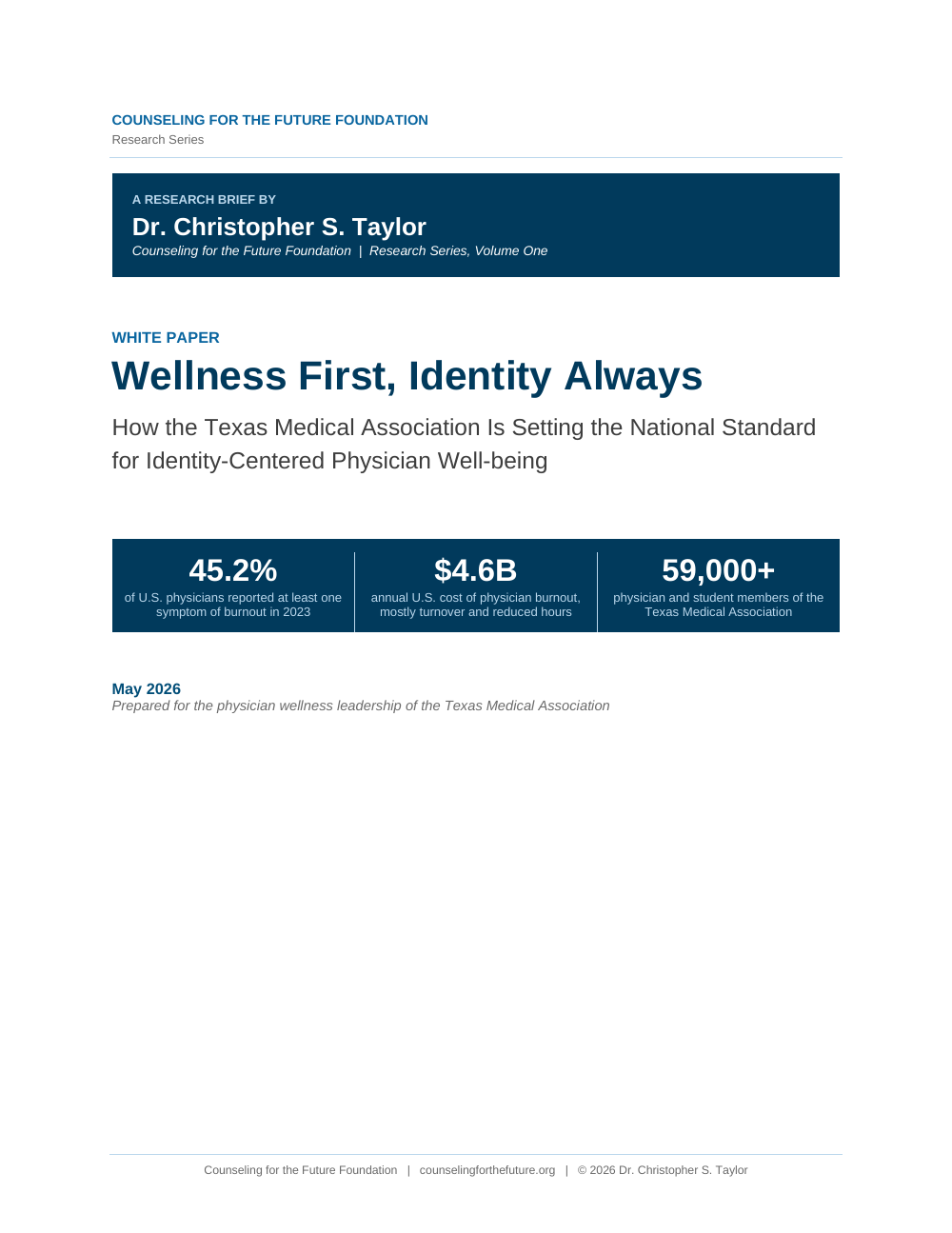
How the Texas Medical Association Is Setting the National Standard for Identity-Centered Physician Well-being
COUNSELING FOR THE FUTURE FOUNDATION
Research Series
A RESEARCH BRIEF BY
Dr. Christopher S. Taylor
Counseling for the Future Foundation | Research Series, Volume One
WHITE PAPER
Wellness First, Identity Always
How the Texas Medical Association Is Setting the National Standard for Identity-Centered Physician Well-being
45.2% | $4.6B | 59,000+ of U.S. physicians reported at least one |
symptom of burnout in 2023 annual U.S. cost of physician burnout, mostly turnover and reduced hours physician and student members of the
Texas Medical Association
May 2026 Prepared for the physician wellness leadership of the Texas Medical Association Counseling for the Future Foundation | counselingforthefuture.org | © 2026 Dr. Christopher S. Taylor
Contents
This brief profiles a problem hiding inside professional success, the wellbeing infrastructure already built to meet it in Texas, and a practical framework for the layer that comes next.
01 The Problem Hiding Inside Success | 02 Why Good Programs Miss the People Who Need Them | 03 What the Texas Medical Association Is Already Getting Right | 04 The Identity Layer | 05 The Business Case | 06 A Practical Path | 07 The Next Decade of Texas Medicine |
•
A Conversation, Not a Pitch
•
References
•
About the Author
Counseling for the Future Foundation | counselingforthefuture.org | © 2026 Dr. Christopher S. Taylor
Executive Summary
Across American medicine, the patients in the most pain are not always the ones whose lives are visibly falling apart. Often they are the ones whose lives, by every external measure, are succeeding. The senior physician fifteen years in. The partner who finally made it. The chair who hit every metric and then quietly began to disappear. I have spent eighteen years sitting with people in exactly that position, and they tend to say a version of the same sentence: I used to know who I was, and I do not anymore. That sentence is not depression in the clinical sense, and it is not burnout in the way most surveys measure it, though it can become either. It is identity strain, the loss of meaning at the precise level of life most people would call arrival. It is common among high performers, it is largely invisible to the instruments built to catch it, and it is expensive when it is left alone. The most recent national data tells an encouraging story and a sobering one at the same time. Physician burnout has fallen from its pandemic peak, with 45.2 percent of physicians reporting at least one symptom of burnout in 2023, down from 62.8 percent in 2021. The good news is real. The harder truth is that nearly half of the profession still carries the load, and the part of that load that lives in meaning and identity is the part our wellbeing programs are least equipped to name. The argument of this brief, in three lines • Traditional wellness programs reach the symptom and miss the source. High performers do not see themselves in generic resilience content, so the people who need it most engage with it least. • The Texas Medical Association has already built more of the right infrastructure than almost any peer body in the country, through Wellness First and its Committee on Physician Health and Wellness. • The next decade of advantage belongs to whoever adds the identity layer on top of that infrastructure. TMA is positioned to be first. This is not a case against the work Texas physicians are already doing for one another. It is a case for the one layer that has been missing from nearly every wellbeing program in the country, and an argument that the Texas Medical Association is unusually well placed to build it first. Counseling for the Future Foundation | counselingforthefuture.org | © 2026 Dr. Christopher S. Taylor
SECTION 1 The problem hiding inside success
The Problem Hiding Inside Success
Start with what the numbers say, because the people who make wellbeing decisions inside a large medical organization respond to evidence before they respond to story, and they are right to. Since 2011, Tait Shanafelt and colleagues have measured physician burnout every three years in Mayo Clinic Proceedings. The series is the closest thing American medicine has to a fixed instrument on this question. It found burnout at 45.5 percent in 2011, climbing to 54.4 percent in 2014, easing to 43.9 percent in 2017, dropping to 38.2 percent in 2020, then spiking to 62.8 percent at the height of the pandemic in 2021. The most recent reading, published in 2025, puts it at 45.2 percent for 2023. Burnout is improving. It is also still sitting on close to half the profession. Figure 1. Physician burnout has eased from its 2021 peak but still affects nearly half the profession. Burnout, as the literature measures it, includes emotional exhaustion and depersonalization among its core dimensions. Those are useful markers. They are also downstream markers. By the time a physician is depersonalizing, the erosion underneath has usually been running for a long time, and it tends to start somewhere a burnout inventory does not look: in the answer to the question who am I now that I have become the thing I trained to be. What identity strain actually looks like A senior physician eighteen years into a career walks into clinic carrying an internal narrative they have never said out loud. By every external measure the career worked. The training paid off, the reputation is intact, the calendar is full. And somewhere in the middle of all that arrival, the meaning thinned out. They are not in crisis. They perform fine in every meeting they are in. That is exactly why no one catches it until the leave of absence, the reduced schedule, or the resignation letter that seems to come from nowhere. Counseling for the Future Foundation | counselingforthefuture.org | © 2026 Dr. Christopher S. Taylor The patients in the most pain were not the ones whose lives were falling apart. They were the ones whose lives, by every external measure, were succeeding. This pattern is recognizable to anyone who has worked the high-performer population for long enough. It is not a workload problem you can staff your way out of, and it is not a resilience deficit you can train away in a workshop. It is a question of identity and meaning, and it requires a framework built for that layer specifically. Most organizations do not have one, because most wellbeing vendors were never trained to build one.
SECTION 2 Why good programs miss the people who need them
Why Good Programs Miss the People Who Need Them Most large medical organizations have done the responsible thing. They run resilience trainings. They license meditation and wellbeing apps. They contract employee assistance programs and stand up physician health committees. None of that is wasted. All of it helps someone. The difficulty is narrow and specific. The highest earners and the most senior clinicians, the exact population whose departure costs the most, are the least likely to engage with generic wellbeing content. A physician earning well into the upper brackets, a partner running their own book of business, a department chair with a national reputation, these are people who have spent a career being the one others lean on. They will not raise a hand in a resilience workshop. They will not admit, on a engagement survey, that the work they trained two decades for has started to feel like nothing on the other side of it. So utilization stays low among the people the program most needs to reach, and leadership is left with a frustrating pattern: spending goes up, programming expands, and the scores that matter most refuse to move. The instinct is to conclude the programs are weak. Usually the programs are fine. What is missing is a layer that speaks to identity and meaning in language a high performer recognizes on the first read, delivered by someone whose credibility survives a Chief Medical Officer and a Chief Financial Officer in the same conversation. Table 1. Two layers of physician wellbeing. What today's wellbeing programs reach What the identity layer reaches Symptoms after they surface: exhaustion and depersonalization The identity question underneath, before symptoms set in Generic content the whole workforce receives Language a senior physician recognizes on the first read Lowest engagement among the highest earners Built for the high-performer population specifically An app subscription or an annual workshop A model recalled at 11 p.m., when no program is in the room Counseling for the Future Foundation | counselingforthefuture.org | © 2026 Dr. Christopher S. Taylor What today's wellbeing programs reach What the identity layer reaches A benefits-line item A driver of retention and sustained performance The gap in one sentence Existing programs are built to measure and manage symptoms. The high-performer population needs a framework built to name and treat the identity question underneath the symptoms, before it becomes a diagnosable disorder or a resignation.
SECTION 3 What Texas is already getting right
What the Texas Medical Association Is Already Getting Right Here is where most white papers would pivot to a sales argument. This one does the opposite, because the honest read of the Texas Medical Association is that it is already further along than nearly any peer body in the country. TMA is the largest state medical society in the nation, representing more than 59,000 physician and medical student members. Through its Wellness First initiative and its Committee on Physician Health and Wellness, the Association has built a genuine wellbeing infrastructure rather than a press release. Members can take continuing medical education on work-life integration, moral distress, boundary setting, and physician suicide at no cost. The Association has contracted confidential counseling for Texas-licensed physicians and their families. And the wider Texas physician community is being recognized for that commitment. In 2025, nine more Texas health care organizations earned the American Medical Association Joy in Medicine recognition, a designation that requires demonstrated system change and proof that an organization is measuring burnout, bringing the state total to eleven. Figure 2. Recognized Texas organizations rose from two to eleven in a single year under the AMA Joy in Medicine program. Counseling for the Future Foundation | counselingforthefuture.org | © 2026 Dr. Christopher S. Taylor That momentum matters for the argument here. It means the institutional will across Texas medicine is already present, the programming already exists, and the leadership already treats physician wellbeing as a real priority rather than a benefits-line afterthought. New TMA President Bradford W. Holland, MD, installed in April 2026, has framed his presidency around protecting the practice of medicine and the physician-patient relationship. He describes the system as a three-legged stool in which physicians are one of the three legs holding patients up. A framework that strengthens the physician leg, at the level of identity and meaning, sits directly inside that vision. This is not a body that needs to be convinced wellbeing matters. It is a body that has already invested, already built, and is positioned to lead. On the Texas Medical Association The point is straightforward. TMA does not need a starting line. It needs the one piece that almost no wellbeing program in the country has yet added: a rigorous, identity-centered layer designed specifically for the high-performer population, that can sit on top of the Wellness First infrastructure already in place.
SECTION 4 The identity layer
The Identity Layer
If burnout inventories measure the symptom, the identity layer addresses the source. The work is built on a simple clinical observation that turns out to have deep roots in the philosophy of meaning: high performers are taught everything about how to succeed and almost nothing about how to survive their own success. I came at this question from an unusual direction. I studied existentialism before I studied clinical counseling, and that sequence matters. Existential thought spent a century on exactly the problem high performers run into at the peak of their careers: what happens to a person when the external markers are all in place and the internal sense of who they are has quietly gone hollow. Bring that lens into a clinical setting, apply it across thousands of sessions with the high-achieving population, and a pattern becomes a framework. I call the framework Empifany. The name is the proper noun, not the point. The point is that identity strain is nameable, it is treatable, and the people around a high performer can be taught to recognize it before it becomes an exit. What the framework changes A framework at this layer does four things a symptom-management program cannot. It gives high performers language for an internal state they have never said out loud, which is the precondition for addressing it at all. It is memorable enough that a stressed physician can recall it at eleven at night, when it matters and no program is in the room. It is transferable, so the same model that helps a physician helps a partner, a chair, and a senior administrator. And it is Counseling for the Future Foundation | counselingforthefuture.org | © 2026 Dr. Christopher S. Taylor rigorous enough to survive a boardroom, because it rests on clinical practice and an academic tradition rather than on inspiration. The position, stated plainly Identity coherence is the precondition for sustained high performance, not the alternative to it. Caring about meaning and driving outcomes are not in tension. The framework treats them as the same project. This is the layer the Texas Medical Association is positioned to own. Not as a replacement for anything in Wellness First, but as the part that finally reaches the senior physicians and high earners the existing programs have struggled to engage.
SECTION 5 The business case
The Business Case
The clinical argument is the reason to care. The financial argument is the reason a CFO signs. They point the same direction. In 2019, Han and colleagues estimated in Annals of Internal Medicine that physician burnout costs the United States roughly 4.6 billion dollars a year, driven mostly by turnover and reduced clinical hours, at an organizational cost of about 7,600 dollars per employed physician per year. Replacing a single physician is widely estimated at two to three times their annual salary once search, hiring, lost revenue, and ramp time are counted. For a senior specialist, that runs well into six figures and beyond before a replacement is even productive.
$4.6B estimated annual U.S. cost of physician |
burnout (Annals of Internal Medicine, 2019)
$7,600 | 2 organizational cost per employed |
physician, per year annual salary to replace a departed physician Set those numbers against the workforce picture. The Association of American Medical Colleges projects a shortage of up to 86,000 physicians by 2036. Every senior physician who leaves early because of unaddressed identity strain is a costly replacement event, often well into six figures for a senior specialist, and a hole in a pipeline that is already too thin. The organizations that solve high-performer retention first will win the talent war that is already underway. Counseling for the Future Foundation | counselingforthefuture.org | © 2026 Dr. Christopher S. Taylor Figure 3. The AAMC projects a shortage of as many as 86,000 physicians by 2036. The reassuring part is that the literature also shows burnout can be reduced with moderate levels of investment, which means there is a real financial basis for organizations to fund the work rather than absorb the loss. An identity-centered layer is one of the lowest-cost, highestleverage additions available, because it targets the most expensive departures specifically: the senior, high-earning clinicians a generic program never reaches.
SECTION 6 A practical path
A Practical Path
Frameworks are easy to admire and hard to adopt, so this one is built to start small and prove itself before it asks for anything. The proposed first step is a single ninety-day pilot with one cohort. A department, a county society chapter, a residency program, or a leadership group. Whatever is easiest to convene. The pilot runs alongside everything the Association already offers. It does not replace Wellness First, the counseling contract, or the physician health committee. It adds the identity layer to one group and measures what happens. Figure 4. The 90-day pilot pathway.
1 | 2 | 3 | 4 Select one cohort |
Measure the baseline Run the 90-day layer Measure and decide A department, county society chapter, residency program, or leadership group. Pre-program wellbeing measurement, self-report and observer instruments. The identity-centered framework, alongside existing Wellness First programming. Post measurement and a clear go or no-go, with full TMA attribution. Counseling for the Future Foundation | counselingforthefuture.org | © 2026 Dr. Christopher S. Taylor What the 90-day pilot includes • One cohort, chosen by the Association for fit and ease of scheduling. • Pre and post wellbeing measurement, using both self-report and observer instruments, so the result is data a CFO can build a budget around. • Full attribution to the Texas Medical Association for any case study the pilot produces. • No cost to participate, and no branding requirement. • A simple decision rule at the end: if the needle does not move, the Association has lost nothing. If it moves, there is a clear, measured path to scale. That is the entire ask at this stage. Not a contract. A measured trial with a defined endpoint and a result either way.
SECTION 7 The next decade of Texas medicine
The Next Decade of Texas Medicine
Picture the Texas Medical Association three years out. Senior physician attrition tied to identity strain has measurably dropped, because physician leaders finally have a language and a clinical pathway for a pattern that used to end in a quiet exit. The work is cited in TMA materials as a differentiator that draws the next generation of physicians, who increasingly choose where to practice based on how seriously an organization takes their inner life. Picture the Association presenting that result at a national physician health conference, with Texas named as the place that saw the high-performer identity question coming before its peers did. Wellness First was the foundation. The identity layer is what turned a strong wellbeing program into a national standard. We identified the high-performer identity question inside our profession before it became a public story, and we built the framework our physicians actually use. The story a wellness leader gets to tell None of that requires the Association to become something it is not. It requires adding one missing layer to an infrastructure that is already among the best in the country, and being willing to go first. Counseling for the Future Foundation | counselingforthefuture.org | © 2026 Dr. Christopher S. Taylor
A Conversation, Not a Pitch
This brief exists because I could not find the framework I needed when I was first sitting with physicians and senior leaders carrying the identity question, and I eventually decided to write it down. I wrote it believing the Texas Medical Association is already living the first chapter of this work. If any of it is useful, the next step is simply a conversation. Twenty minutes, physician leader to clinician, to talk through whether the framework fits your physician population and what a single pilot cohort might look like. I will bring the citations, the framework summary, and the pilot design, and I am glad to brief whichever medical staff leader or financial officer needs to hear it directly. I have spent eighteen years in those rooms, and I currently serve as Vice Chair of the body that licenses every professional counselor in Texas, so I have a fair sense of what your colleagues and your CFO will ask. The next step A 20-minute conversation about fit. No cost, no commitment, no slide deck. Bring the one cohort you would most want to start with, and we will design a pilot around it together.
References
1. Shanafelt TD, West CP, Sinsky C, et al. Changes in Burnout and Satisfaction With Work-Life Integration in Physicians and the General US Working Population Between 2011 and 2023. Mayo Clinic Proceedings. 2025;100(7). doi:10.1016/j.mayocp.2024.11.031. 2. Han S, Shanafelt TD, Sinsky CA, et al. Estimating the Attributable Cost of Physician Burnout in the United States. Annals of Internal Medicine. 2019;170(11):784-790. doi:10.7326/M18-1422. 3. American Medical Association. National physician burnout survey results, 2023. ama-assn.org. 4. Texas Medical Association. Wellness First and the Committee on Physician Health and Wellness. texmed.org/wellnessfirst. 5. Texas Medical Association. Bradford W. Holland, MD, installed as 161st TMA president, April 2026. texmed.org. 6. Association of American Medical Colleges. The Complexities of Physician Supply and Demand: Projections From 2021 to 2036. March 2024. aamc.org. 7. American Medical Association. Joy in Medicine Health System Recognition Program; Texas recognized organizations, 2025, as reported by the Texas Medical Association (texmed.org), September 2025. All statistics in this brief are drawn from the published sources above and current as of May 2026. Where the most recent data differs from earlier figures, the most recent reading is used. Counseling for the Future Foundation | counselingforthefuture.org | © 2026 Dr. Christopher S. Taylor
About the Author
Dr. Christopher S. Taylor, LPC-S
Owner, Taylor Counseling Group | President, Counseling for the Future Foundation |
Creator of Empifany
Christopher Taylor is the founder and owner of Taylor Counseling Group, which he launched in 2015 and has grown to twelve locations across Texas, built around a commitment to affordable, high-quality care. He serves as Vice Chair of the Texas State Board of Examiners of Professional Counselors, the body that licenses every professional counselor in the state, a role he was first appointed to by Governor Greg Abbott. He was appointed to the Texas Rural Health Task Force in 2016 and has served on the board of the Grant Halliburton Foundation since 2022. He holds a master's degree in counseling from Dallas Theological Seminary, studied philosophy and existentialism at Texas A&M University, and completed doctoral coursework in counseling education. He teaches counseling ethics as adjunct faculty at Dallas Theological Seminary and Amberton University. He is the author of My Digital Practice and the creator of the Empifany framework, and is the author of the forthcoming book You Are Here. Counseling for the Future Foundation Research Series, Volume One | May 2026 counselingforthefuture.org Counseling for the Future Foundation | counselingforthefuture.org | © 2026 Dr. Christopher S. Taylor
Download the full white paper
Get the PDF delivered to your inbox.